All about Louis Vuitton date codes – understanding formats, locations and meanings

Want to learn how to read a Louis Vuitton date code correctly – and what information it can provide about the bag’s origin, age and value?

Date codes are an important tool in authentication, but they can never stand alone as proof of authenticity. They should always be assessed in conjunction with other characteristics of the bag: the “Made in …” stamp, logo, materials, stitching, hardware and lining. This principle is similar to what we have discussed in the article How to recognize a genuine Louis Vuitton bag – materials, logo, stitching and date codes.

This guide is for informational purposes only and is based on publicly available information, industry sources, collector archives, authentication databases, applicable Industry Authentication Standards and many years of experience with authentic Louis Vuitton bags.

In this guide, we will cover:

  1. What is a date code?
  2. Historical development: 1980s to present
  3. Typical locations – where can I find the date code?
  4. Techniques – how is the date code applied?
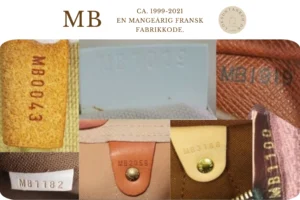
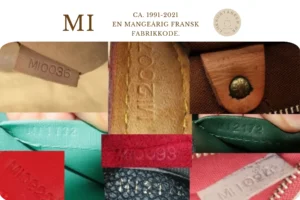
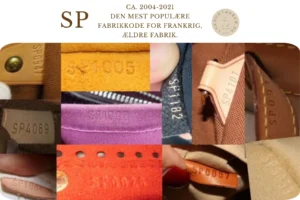
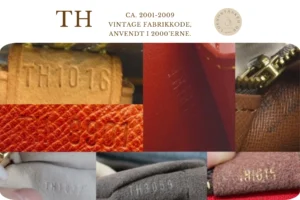
  5. Datacodes – Overview of Factory Codes
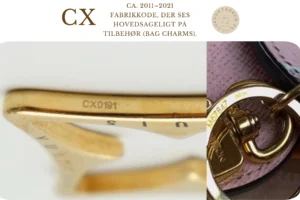
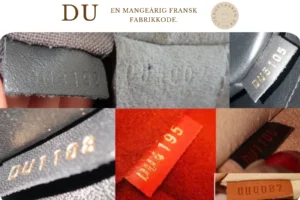
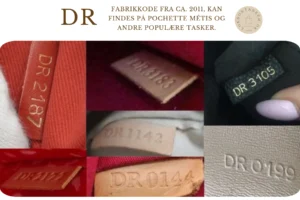
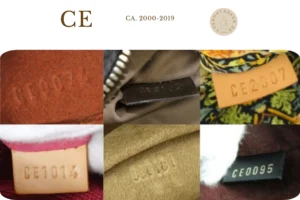
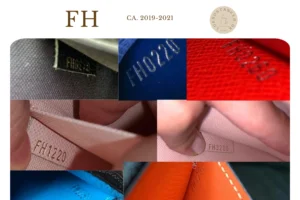
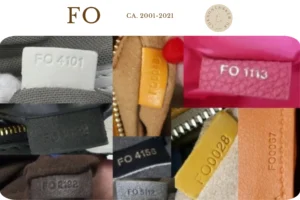
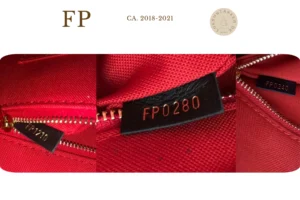
  6. List of Louis Vuitton factory letters – with examples of the most common codes for each country of production
  7. Special and rare examples
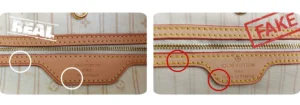
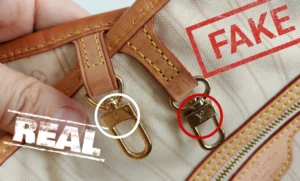
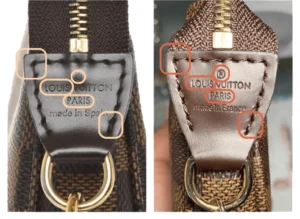
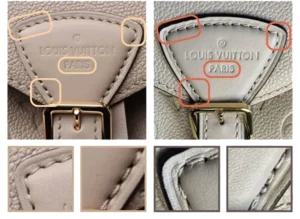
  8. Typical errors on counterfeit codes
  9. Conclusion: Use the code with care


1. What is a date code?

A date code is a combination of letters and numbers, embossed or stamped on the leather or lining of a Louis Vuitton bag or accessory.

These stamps indicate the date of production and the country of production, and are used by collectors and buyers to verify the authenticity of a product.

In this guide, we explain what date codes mean, how to read them, and why they play an important role in assessing the authenticity of pre-loved and vintage bags.

The history of Louis Vuitton date codes

Although the French fashion house Louis Vuitton was founded as early as 1854, the first date codes were not introduced until 128 years later.

For many years, this was probably unnecessary, as the brand had patented production methods for both locks, canvas, and leather, making imitations almost impossible.

However, from the early 1980s, Louis Vuitton decided to add date codes to all bags and accessories.

The codes have since changed format, location and meaning several times – in line with the brand’s growing production and the need for more detailed information.

Date codes were used until March 2021, when Louis Vuitton switched to embedded microchips as a more secure and modern form of identification.

How to read a date code

• The letters indicate the country where the item was produced.

• The numbers indicate the week, month or year of production (depending on the period and format).

It is important to know that the date code is not a unique serial number, but a supporting element in the overall assessment of authenticity.

💡 Expert tip: Many replicas use realistic or directly copied date codes. Therefore, the code should always be assessed in conjunction with other authenticity details – such as materials, stitching, hardware, logo and Made in marking.

Date Codes and Authenticity – What to Remember

Date codes are just one part of a bigger authenticity picture.

A genuine Louis Vuitton bag is characterized by the quality of the materials, the precision of the stitching, the weight of the hardware and the overall finish.

At luksustasker.dk, we always evaluate the date code along with more than 30 different parameters before approving a bag as genuine.

Also read: How to recognize a genuine Louis Vuitton bag – materials, logo, stitching and date codes.

2. Historical development – ​​from the 1980s to today

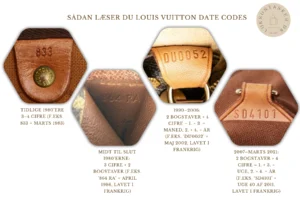
Before 1982

No standardized date codes. Bags were identified via stamps and labels.

1982 – mid-1980s:

• First: 3–4 digits (YYM / YYMM).

– Example: 823 = March 1982;

– Example:8312 = December 1983.


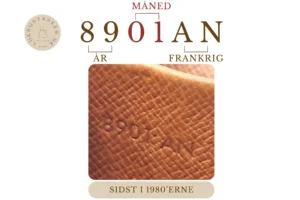
Mid/late 1980s: 3–4 digits followed by 2 letters (numbers → letters).

– Example: 8901AN = January 1989 (France);

– Example: 874VX = April 1987 (France).

Note: Some sources mention that letters began to appear before the digits in the late 1980s (e.g. VI8610). To avoid confusion, we follow the convention here (numbers → letters) and explain that there was a transitional period with both variants.


1990 – 2006

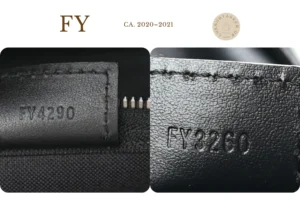
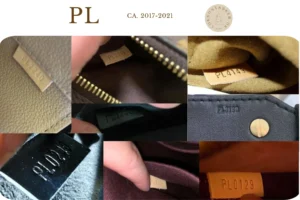
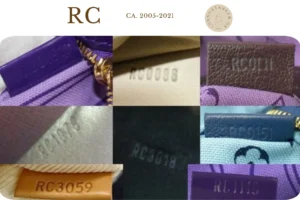
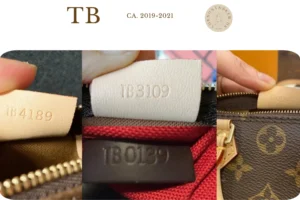
• Format: 2 letters + 4 digits.

• 1st & 3rd number = month, 2nd & 4th number = year.

– Example: FL0022 = February 2002 (France).

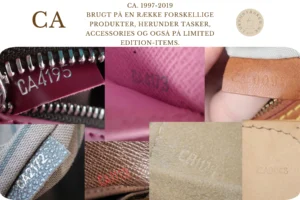
– Example: CA0012 =January 2002 (Spain).


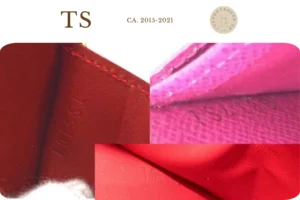
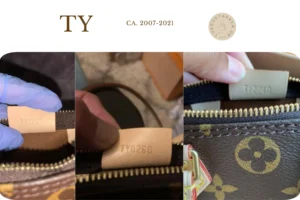
2007 – February 28, 2021

• Format still: 2 letters + 4 digits.

• 1st & 3rd number = week, 2nd & 4th number = year.


– Example: CA1088 = week 18 in 2008 (Spain).

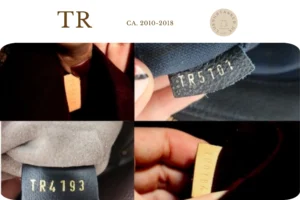
– Example: TR3117 = week 31 in 2017 (France).

💡Expert tip: The transition took place in late 2006 / early 2007 – therefore bags with both systems are available in this period.


From March 1, 2021

• Louis Vuitton has phased out visible date codes in favor of an NFC/RFID chip that stores information digitally.

• The transition officially took place on March 1, 2021. However, some models produced at the beginning of the year may still have both a code and a chip.

• Chip data is not always available to consumers – it is primarily used by Louis Vuitton itself and by professional authentication partners.

3. Typical locations – where can I find the date code?

Typical locations – where can I find the date code?

Generally, a date code in a Louis Vuitton bag is located inside the bag – typically close to the seams and often in connection with a pocket.

To find the date code on your bag, first examine the interior pockets. In most cases, you will find the code either embossed on a small leather patch inside the pocket or stamped directly into the lining. Look carefully, especially if the bag has an Alcantara lining, as the code may be faded and almost invisible.

Below you can see where the date code is most often located on some of the most popular Louis Vuitton models:

Louis Vuitton Speedy

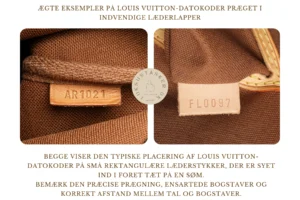
On a Speedy – regardless of size – you will find the date code under the inside pocket. The code is embossed on one of the two small leather patches by the pocket.

Louis Vuitton Neverfull

On the classic Neverfull, the date code is located under the large fabric pocket on the right side (when looking directly at the pocket).

Note that an Epi leather Neverfull may have the date code in a different location – namely on the inside of one of the handles, exactly where the handle meets the upper leather edge.

Louis Vuitton Pochette Métis

On a Pochette Métis, you will find the date code in the outside zipper pocket on the back of the bag. Open the pocket and you will be able to see the code if the bag was produced between 2014 and 2021.

Louis Vuitton Toiletry Pouch 26

The date code is located inside near the top, embossed directly into the leather lining along one of the side seams.

Louis Vuitton Artsy

The code is located on the lining inside one of the interior pockets – this model usually does not have a leather patch.

Louis Vuitton Palm Springs Mini Backpack

The date code is typically found inside on the right side, embossed on a small leather patch that sits by the interior pocket.

💡 Expert tip:

If you can’t find the date code, it doesn’t necessarily mean that the bag is fake. Starting in 2021, Louis Vuitton began gradually phasing out the classic date codes and replacing them with microchips that can only be scanned by authorized retailers.

4. Techniques – How are date codes applied?

Louis Vuitton Date Code Location

The location of Louis Vuitton date codes varies depending on the model and year of production.

Knowing where to look for these stamps makes authenticating and dating bags more accurate and efficient.

Interior Leather Patches:

The date code is most often found on a rectangular leather patch sewn into the lining along a seam.

This is the most common location of date codes on Louis Vuitton bags.

Direct embossing:

On some models, the date code is embossed directly into the lining or in a discreet place in the bag, e.g. close to the top edge of an inside pocket.

Inside pockets:

Date codes are often found along the top edge of inside pockets or on a riveted leather patch under a loose inside pocket.

On some models, such as the Speedy, the date code is embossed on a leather patch sewn into the inside seam.

5. Datacodes – Overview of Factory Codes

Overlapping Louis Vuitton Factory Codes – Full Explanation

SD – France / USA

• Older models (before the mid-1990s): mostly France.

• Newer models (from the mid-1990s onwards): most often USA (San Dimas, California).

• History: Started as a French code, but was adopted for American production during the 1990s.

• Typical use: Very common on canvas bags from the USA in the 1990s and 2000s.

• Check: Compare the date code with the “Made in …” stamp and other signs of authenticity (materials, stitching, hardware).

FL – France / USA

• Most common: France.

• History: Original French code; also documented on bags from the USA, especially in the 1990s.

• Typical use: American series in the 1990s.

• Check: Compare the date code with the “Made in …” stamp and other signs of authenticity (materials, stitching, hardware).

SA – France / Italy

• Most common: France.

• History: Known as a French code in the 1990s on classic bags. Later also seen in Italy, especially on smaller leather goods.

• Typical use: Classic bags (France), wallets/belts (Italy).

• Check: Compare the date code with the “Made in …” stamp and other signs of authenticity (materials, stitching, hardware).

LA – France / USA

• Most common: USA (San Dimas, California).

• History: Appeared in France in the 1980s and early 1990s. From the late 1990s it is mainly seen in the USA.

• Typical use: Bags from the 1990s and early 2000s.

• Check: Compare the date code with the “Made in …” stamp and other signs of authenticity (materials, stitching, hardware).

LW – Spain / France

• Most common: Spain (Toledo).

• History: Used in Spain since the 1990s; a few cases documented in France, but without a fixed period.

• Typical use: Speedy and accessories produced in parallel in Spain and France.

• Check: Compare the date code with the “Made in …” stamp and other signs of authenticity (materials, stitching, hardware).

BC – Italy / Spain

• Most common: Italy.

• History: Used in Italy since the 1980s. Also used in Spain in the 2000s in connection with production restructuring.

• Typical use: Often on SLG (wallets, cardholders).

• Check: Compare the date code with the “Made in …” stamp and other signs of authenticity (materials, stitching, hardware).

💡Expert tip: General check (applies to all codes above)

The letters in the date code should always match the “Made in …” stamp on the bag. If they do not match, it is a clear red flag.

💡Note

Louis Vuitton has never published an official list of factory codes.

The information presented here is based on well-documented observations and many years of experience with authentic bags. Variations may occur, and factory codes alone do not prove authenticity.

They should therefore always be assessed together with other authenticity criteria such as materials, stitching, hardware, lining and the “Made in …” stamp.

The dates for SA, LA, LW and BC are indicative, as there are no official dates for any changes between countries. The information is based on well-documented observations and many years of experience.


Do you want to know where and how Louis Vuitton bags are created – and what characterizes genuine craftsmanship?

Read our article with authentic examples of heat stamps, date codes and ‘‘Made in U.S.A. of imported materials’’ labels – including on models such as the Neverfull, Speedy and Pochette Métis.

Read the full guide

Made in France… or? Where are Louis Vuitton bags made today? and learn about Louis Vuitton’s production, authenticity and craftsmanship.


6. List of Louis Vuitton factory letters – with examples of the most common codes for each country of production

Many people mistakenly believe that a genuine date code automatically means that the bag is genuine. Unfortunately, this is not the case.

To assess authenticity, several factors must be taken into account – not only the date code itself, but also the font, the color of the embossing, its location and the overall impression of the bag.

Proper authentication requires that the date code be assessed in conjunction with other characteristics:

• The “Made in…” stamp

• The Louis Vuitton logo and its precision

• Materials and leather type

• Stitching and craftsmanship

• Hardware and zippers

• Interior lining and labels

Below are some of the most common fonts used for date codes. Please note that the list is not exhaustive and is constantly updated – although Louis Vuitton no longer uses date codes on newer models.

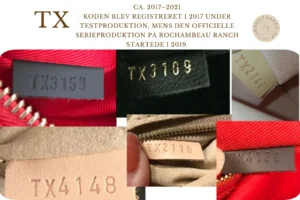
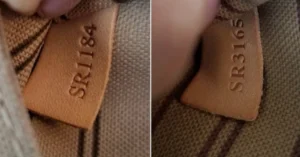
List of Louis Vuitton Date Codes (Made in France)

France is the home country of Louis Vuitton and the main production site for the brand’s leather goods. The majority of Louis Vuitton’s classic and exclusive bags are made here – from the iconic models produced in the Atelier Asnières near Paris to modern workshops spread across the country.

French models are marked “Made in France” and are characterized by precision, quality craftsmanship and a long tradition of savoir-faire. The date codes from the French workshops follow the same structure as in the other countries, but are recognized by specific factory letters that show that the bag was made in France.


List of Louis Vuitton date codes (Made in Spain)

Louis Vuitton has been producing bags and small leather goods in Spain for many years – especially in the areas around Barcelona and Girona, where there is a long tradition of craftsmanship and leather production. The Spanish workshops are an important part of Louis Vuitton’s European production and are responsible for a large part of the brand’s popular models.

The date codes from the Spanish ateliers follow the same structure as in other European countries, but are distinguished by special factory letters that identify that the bag was made in Spain.

Below you will find an overview of the most well-known Spanish factory abbreviations that appear on genuine Louis Vuitton bags marked Made in Spain.

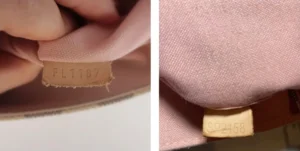
List of Louis Vuitton date codes (Made in Italy)
For many years, Louis Vuitton has had selected bags and small leather goods produced in Italy – especially in Tuscany, which is known for its strong leather goods and craftsmanship. The Italian workshops produce both classic models and accessories in line with the French and Spanish ateliers. The date codes from Italian workshops follow the same structure as in other EU countries and are distinguished by special factory letters that indicate that the item was made in Italy. Below you will find an overview of the most well-known Italian factory abbreviations that can be seen on genuine Louis Vuitton bags marked Made in Italy.


List of Louis Vuitton Date Codes (Made in U.S.A.)

Louis Vuitton has been producing in the United States for more than three decades, where the brand operates several leather workshops in California and at Rochambeau Ranch in Texas (Johnson County). The American workshops produce bags and small leather goods for the North American market to exactly the same quality standards as the European workshops.

American models are marked “Made in U.S.A.” – either embossed directly into the leather or on a separate label with the text “Made in U.S.A. of imported materials”. This addition means that the materials (leather, lining and hardware) are imported from Europe, while the bag itself is assembled in the United States.

The date codes from the American workshops follow the same structure as in European countries, but are distinguished by specific factory letters, which indicate that the bag is made in the United States.


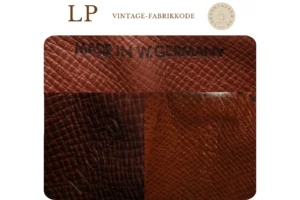
List of Louis Vuitton Date Codes (Made in Germany)

It is rare to see Made in Germany on Louis Vuitton bags. When it does appear, it is usually vintage or special editions. Officially, Louis Vuitton states that leather goods are made in France, Spain, Italy and the USA; therefore, German date codes are considered exceptions in an archival/vintage context. 

Examples of factory letters documented in the market: LP, OL.


7. Special and rare examples

• Saks Fifth Avenue & Neiman Marcus:

In the 1970s and 1980s, these American department stores sold exclusive Louis Vuitton models, made specifically for the American market.

The bags were often provided with foil stamps or small metal plates with the name of the department store.

They were produced in collaboration with The French Luggage Company and used original Louis Vuitton canvas under official license. Today they are considered rare collector’s items.

• The French Luggage Company (USA, c. 1976–1991):

Louis Vuitton established a licensing partnership during this period to meet the growing demand in the United States.

The bags were sold through luxury retailers such as Saks Fifth Avenue, Neiman Marcus and Myers, and are characterized by:

– Tyvek tags instead of leather tags,

– lack of date codes,

– different hardware and zippers.

Although these models differ from the European versions, they are 100% authentic and documented as part of Louis Vuitton’s official licensed production.

💡 Expert tip: Bags from The French Luggage Company are often mistaken for replicas because they do not have date codes. A correct assessment should therefore be based on materials, stitching and the precision of the logo, not just the marking.

8. Typical errors in counterfeit codes

Counterfeit date codes often reveal themselves by:

• wrong font or mismatched letters

• too deep or uneven embossing

• incorrect spacing between numbers and letters

• codes that do not match the Made in label

💡Expert tip: Use our photo guide as a reference for typical errors (font, depth, spacing, mismatch with Made in), and always evaluate the code in conjunction with other details.

9. Conclusion – use the date code wisely

A Louis Vuitton date code can provide valuable insight into a bag’s origin – but it should never stand alone.

At luksustasker.dk, we evaluate each bag based on more than 30 authentication parameters: materials, stitching, logo, hardware, age, accessories and much more.

Are you looking for a Louis Vuitton bag with documented origin and professional authenticity assessment?

Explore our current selection here: luksustasker.dk/shop

We know how important it is to feel safe when investing in luxury – especially in the pre-loved market.

Do you have questions or need personal guidance?

Contact us – we will be happy to help you make an informed and safe choice.


What does a genuine Mulberry serial number look like – and what numbers are typically used on replicas?

When buying a pre-loved Mulberry bag, the serial number is an important part of the authentication – but it should never stand alone. It should always be considered in conjunction with the bag’s other characteristics – including the metal disc, leather type, stitching and logo – as well as other key factors, as we have described in the blog post Sådan sådan gekender-du-en-aegte-mulberry-taske – detaljer, numre og materialer”.

That is why we have put together this guide to give you a clear and up-to-date overview of how the authentication of Mulberry bags is done in practice.

This guide is for informational purposes only and is based on publicly available information, industry sources, collector archives, authentication databases, applicable Industry Authentication Standards and many years of experience with authentic Mulberry bags.


In this guide we will cover:

  1. Origin and development of the Mulberry metal disc
  2. How to recognise a genuine Mulberry metal disc – the front, logo and details over time
  3. Counterfeit Mulberry serial numbers: The typical telltale signs
  4. Commonly used copy numbers on counterfeit Mulberry bags (2026)


1. Origin and development of the Mulberry metal disc

Mulberry’s iconic round metal disc has been a central part of the brand’s identity since the early 1990s. It was first introduced as an aesthetic and functional element that was meant to reflect Mulberry’s craftsmanship, authenticity and British design tradition.

Did you know?

Mulberry was founded in 1971 in Somerset, England, originally focusing on belts and small leather goods.

Founder Roger Saul started the business at his kitchen table at the age of just 21, with an investment of £500, which he received as a birthday present from his mother.

The name and logo with the mulberry tree are inspired by his childhood memories of the area where he grew up.

The logo was designed by his sister, Helen, which gives the brand’s identity a personal and family touch.

It was not until the 1980s that Mulberry began to seriously design the bags that are now considered iconic.

  • Older vintage models without metal disc

Vintage bags from the late 1980s and early 1990s were produced without the characteristic round metal disc with Mulberry’s mulberry tree logo on the inside.

At this time, Mulberry had a more informal approach to branding and identification – neither serial numbers nor metal discs were yet standard.

The absence of a metal disc is therefore not in itself a sign of a copy, as long as the other details – such as the logo, leather type, stitching, hardware, etc. – are correct consistent with Mulberry’s authentic quality and style from the period.

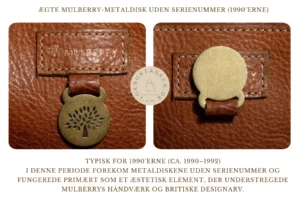
  • Older models with metal disk – but without serial number (approx. 1990–1992)

The first generations:

At the beginning of In the 1990s, Mulberry began using the characteristic round metal disc with the mulberry tree logo, placed either on the inside or outside of the bag – depending on the model and design.

During this period, it was quite normal for the back of the metal disc to be blank, i.e. without a serial number.

At that time, the metal disc primarily functioned as a visual design element that signaled the brand’s identity, but did not yet have any function in terms of traceability or authentication via serial number.

Mulberry bags from this period can therefore easily be original, even if the disc does not have a number – provided that the logo, leather, stitching and hardware match Mulberry’s known quality.

This simple approach was gradually replaced as the need for authentication and protection against copycat products grew.

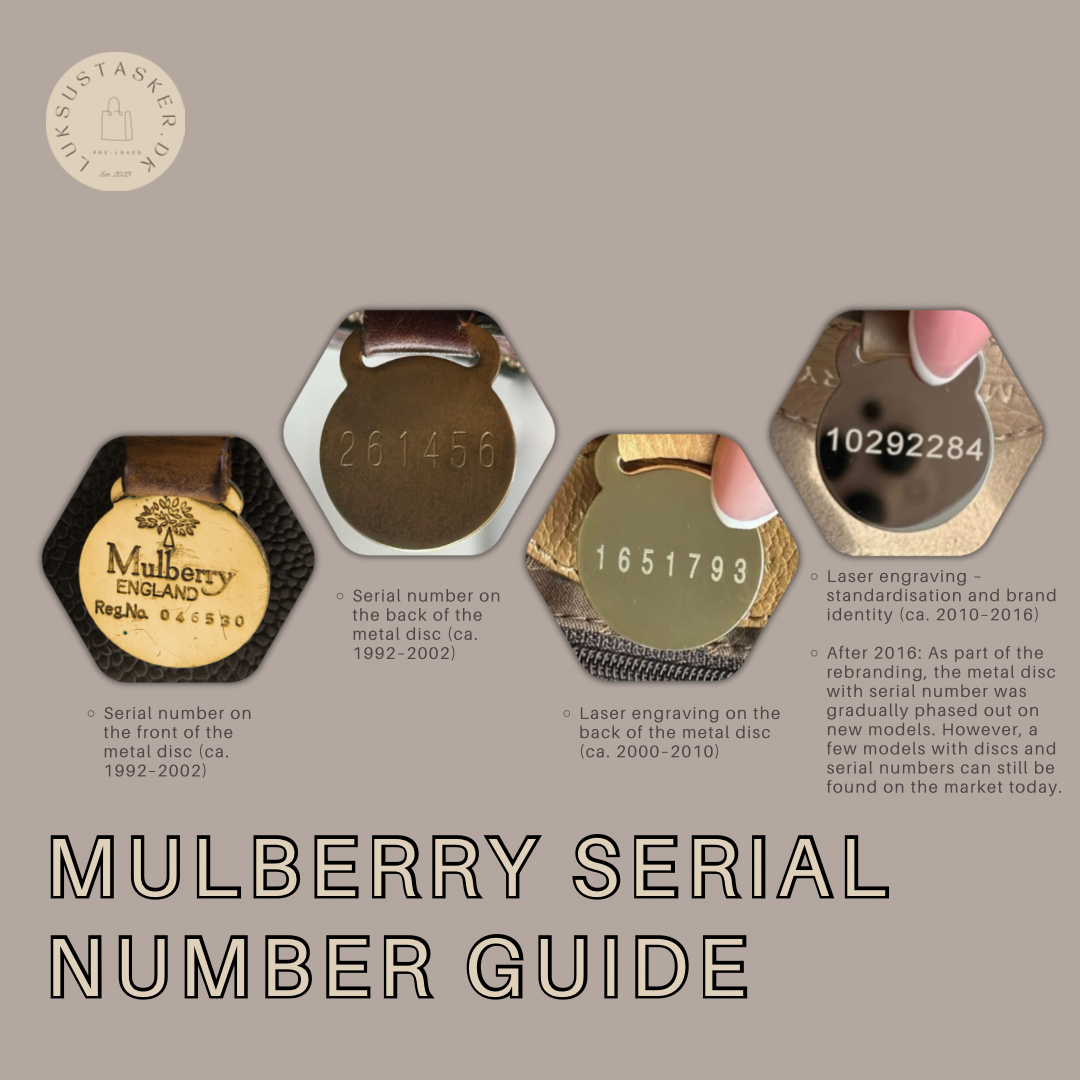
  • Gradual introduction of serial numbers (c. 1992–2002)

From around 1992, Mulberry gradually began adding serial numbers to metal discs as part of a strengthened anti-counterfeiting effort.

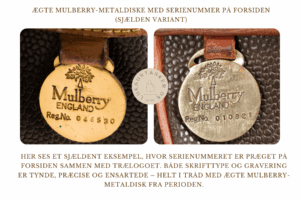
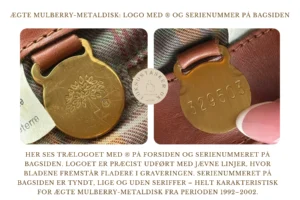
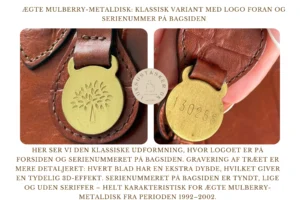
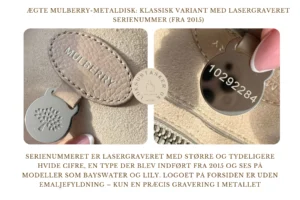
The first numbers were mechanically embossed on the front near the logo, and later placed on the back of the disc. Common to these early numbers was that they were thin, precise and sans serif – like the logo itself. This characteristic makes them easy to distinguish from replicas.

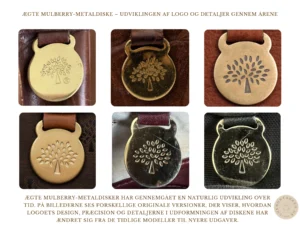
When evaluating Mulberry bags from this period, it is important to remember that the metal discs that belong to this timeline share a number of common characteristics. This applies in particular to the execution of the logo, the detailing of the name, and the fine and precise lines.

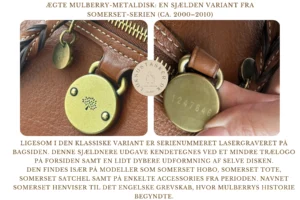
Below are examples where you can also observe variations in the engraving depth of the logo, as well as differences in the location of the serial number (on the front or back of the metal disc). These are production variations – not signs of a replica.

These nuances are fundamental in the authentication of vintage Mulberry bags.

Below are three authentic examples of Mulberry metal disks from the period, clearly showing the differences in detail.

This phase laid the foundation for the next step – a more systematic labeling and improved security, which became standard around the year 2000.

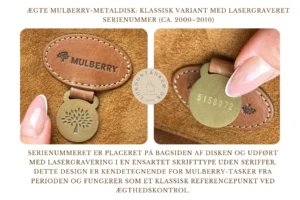
  • Approx. 2000–2010: transition period from embossing to laser engraving

During this period, the design of the serial numbers changed significantly:

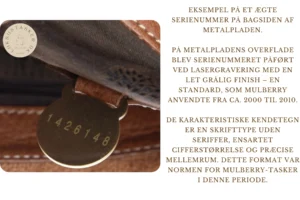
• Mulberry continued to use metal discs with serial numbers, but the way in which the numbers were applied changed. Whereas earlier numbers were mechanically embossed as thin impressions in the metal, laser engraving began to be used from around 2002.

• The laser engraving was always done in white with a uniform sans-serif font. Font, size and spacing between digits were standardized as Mulberry’s standard for serial numbers.

During this period, serial numbers served both for internal identification and as a protection against counterfeit products.

💡 Expert tip: A light patina may develop on genuine vintage serial numbers over time: the numbers do not appear completely white, but take on a greyish hue. This is completely natural and a clear sign of age. Even after cleaning, the numbers will not disappear, as they were laser engraved and not applied with paint.

💡 Expert tip: Mulberry has never used black numbers on serial numbers. If you see a serial number with black or colored digits, it is a sure sign of a copy.

Today, serial numbers play a central role in assessing authenticity, but they should never stand alone. They should always be seen in the context of leather, stitching, hardware, logo and other details – as we have described in the blog post “How to recognize a genuine Mulberry bag – details, numbers and materials”.

  • 2010–2016: Standardization and brand identity

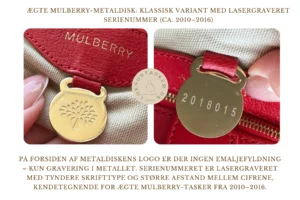
From around 2010, Mulberry refined the design of the metal discs, as well as the technique of laser engraving of serial numbers. In the previous period (approximately 2000–2010) on Mulberry models, it was clear that the front of the disc with the logo had a distinctive feature – the wooden logo with gray enamel (colored filling in the recesses of the engraving).• This was a special design element, easily recognizable and part of the brand’s visual identity.

From 2010, Mulberry changed its approach:

• The wooden logo on the disc became without colored enamel – only an embossed engraving in the metal.

• All new collections were then produced with a “pure” metal logo (bronze, gold, silver – depending on the model).

• The absence of black or gray enamel is therefore the norm for genuine bags after 2010 and not a sign of a copy.

It is also important to note that the serial numbers themselves changed their appearance during this period:

• the numbers appeared whiter and with a slightly greater distance between the digits,

• the font became slightly thinner compared to the period 2000–2010,

• the engraving became more precise and uniform – a clear mark of quality for bags from this era.


This form of serial numbers and the updated disk design became an integral part of Mulberry’s visual identity and an important reference point in assessing authenticity.

Exceptions and special models:

• Certain mini versions or accessories – e.g. small clutches, cosmetic bags or wallets – could lack a metal disc even during this period.

• Limited or seasonal models, especially made of textile (non-leather), were sometimes produced with a different type of marking – e.g. an embossed logo on a leather label.

  • Transition period 2015–2016: Rebranding

During this period, two different variants of serial numbers were used in parallel. The choice of type depended on the model, production batch and the factory in question.

• One variant was the classic numbers that Mulberry used from around 2010 to 2016 on the majority of the collection. They are characterised by a fine, white laser engraving with relatively small digits. Examples of this can be seen in the section 2010–2016: standardisation and brand identity.

• The second variant was newer and more distinctive, with larger and clearer white numbers, such as can be seen in examples of models such as Bayswater and Lily (read more about this type further down in the article).

This parallel practice makes the period 2015–2016 a clear transitional phase in Mulberry’s design history.

  • From 2015: Enlarged serial numbers with white laser engraving

Around 2015, Mulberry gradually began using a new type of serial number, where the digits appear slightly larger than in the previous period.

The images clearly show the difference compared to the serial numbers we have described in the section about 2010–2016: standardization and brand identity.

• The serial number is made in white laser engraving with a more precise and uniform cut.

• The font is still sans-serif, but the lines are slightly thicker, which gives the numbers a sharper and more distinctive expression.

• The spacing between the digits is even and standardized, supporting a more modern and refined look compared to the previous, smaller digits.

  • After 2016: Modern Mulberry bags: rebranding and gradual phasing out of the metal disc with the serial number

Since 2016, Mulberry has gradually removed the classic metal disc with the serial number on a number of new models. This was part of the brand’s rebranding under Johnny Coca and Thierry Andretta, which introduced a more minimalist and modern look.

Models without a metal disc (fully or partially):

• Softie

• Iris

• Portobello

• Amberley

• Lily (some newer versions)

• Other collections with softer silhouettes

The phasing out of the metal plate has taken place gradually over the course of nearly a decade. As of 2025, only a few models on Mulberry’s official website still featured a metal plate with a serial number—primarily the classic Bayswater, along with selected versions of the Lily.

In 2026, however, Mulberry has expanded the use of the serial-number metal plate across a wider range of models, including the Boston, Woven Tote, Scotchgrain Bucket, Crochet Bucket, Crochet Tote, Crochet Crossbody Bag, Heritage Briefcase, Heritage Zipped Backpack, North South Shopper, and Heritage Medium Clipper. On the official Mulberry website, these models now appear alongside the classic designs, all featuring the serial number on a metal plate positioned on the exterior of the bag.

The 2026 trend clearly signals a return to the metal plate as an integral part of Mulberry’s design DNA.

The serial numbers on these models are identical to the type that Mulberry started using from 2015: larger and clearer white digits, an example of which can be seen in the section 2015–2016: Rebranding and transition period above.

The classic Lily model can still be found with a serial number.

• On the Lily Medium, the metal disc is available in all colours.

• On the Lily in the classic size, the disc is only retained in the basic colours.

• New seasonal colours such as Orchid Bloom Heavy Grain, Brighton Blue Heavy Grain and Chalk Heavy Grain are already produced without a disc – as part of the rebranding.

The decision to phase out the metal plate was driven by several factors: the desire for a more minimalist and modern design expression, reducing weight and wear on the leather, and the fact that the metal plate was increasingly being copied by counterfeiters and therefore losing its value as a marker of authenticity.

Instead, Mulberry chose to strengthen the overall impression through materials, stitching and hardware, which better reflects the brand’s contemporary luxury aesthetic.

 💡 Important to remember: The absence of a metal plate or serial number is not a sign of a copy, as long as the bag otherwise complies with Mulberry’s official standards.


Stability of logo and aesthetics

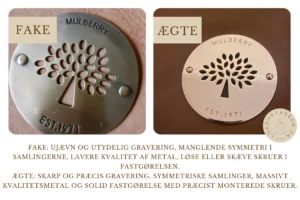
Throughout the period, the Mulberry logo on the front of the metal plate had a high degree of consistency: the shape of the leaves always had pointed ends, and each leaf was executed with precision and correctly positioned in relation to the brand’s official graphics at the time. The size of the logo could vary slightly, but the quality of the engraving always reflected Mulberry’s high standards of craftsmanship.

2. How to recognize a genuine Mulberry metal disc – the front, the logo and the details over time

When assessing the authenticity of a Mulberry bag, the front of the metal disc plays a crucial role. It is here that the difference between the original and the copy often becomes most apparent.

In this section, we will focus on the front of the metal discs, while in the following article we will examine the back in detail – including serial numbers, engravings and an overview of Frequently Used Copy Numbers on Counterfeit Mulberry Bags (2026).

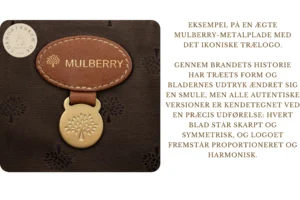
On genuine Mulberry discs, the mulberry tree logo is always present. The logo has undergone a few changes since the 1980s, but the key elements – the shape of the tree, the balance of the design and the precision of the workmanship – have always been preserved. It is these details that help to distinguish an original from a copy.

By analysing the contours of the tree, the precision of the engraving and the proportions, it is clear how Mulberry has refined its design and craftsmanship standards over different periods.

In this section, we will review the main characteristics of a genuine Mulberry metal disc and show how you can use the front as a sure guide for authentication.

The image below shows different original metal disc versions, illustrating how both the logo and the details have evolved – from the early models to the more recent editions.

The tree logo: the most important starting point

Over the decades, the Mulberry tree has changed only minimally: the thickness of the lines and the proportions of the crown have been adjusted. However, the basic aesthetics have always been preserved – sharp leaves, symmetry and precise details remain firm hallmarks of authenticity.

The leaves are always clearly marked and placed symmetrically. The crown of the tree is harmonious and balanced, and even small deviations in the proportions can point to a copy.

  • Each leaf should have sharp, well-defined ends, and the placement should match the brand’s official graphics exactly.
  • The logo should be embossed with depth and precision – never flat, rough or asymmetrical.
  • The engraving should appear clean and balanced – without blurring, misaligned lines or incorrect proportions.
  • The size of the logo may vary slightly between years, but the shape and placement are always consistent.

A genuine metal disc is not just a decorative element – ​​it represents Mulberry’s heritage and craftsmanship, where even microscopic details count.

Material and weight

Genuine Mulberry metal plates are typically made of brass, which gives them a characteristic golden sheen. Less commonly, variants with a silver or bronze-colored coating are seen. The surface is always smooth, uniform and resistant to wear. Distortions in the details of the wood – leaf shape, crown proportions or trunk contours – are signs of a copy.

💡 Expert tip: Use a magnifying glass or macro photo to check the details – genuine engraving reveals quality when enlarged

3. Fake Mulberry serial numbers: The typical telltale signs

Many copies of Mulberry bags are revealed by one particular detail: the serial number. At first glance, it may look similar to the original – but with the right eye, you will quickly discover small but clear differences.

At luksustasker.dk, we have reviewed and documented over 1000 Mulberry bags – from the earliest limited edition models to the latest collections. We know exactly what each model should look like – down to the smallest details like engraving, placement and font. In this guide, we share our knowledge of the most common mistakes in fake serial numbers so you can confidently distinguish between the real thing and a copy.

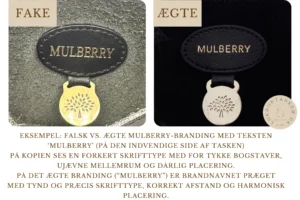
Font and number form

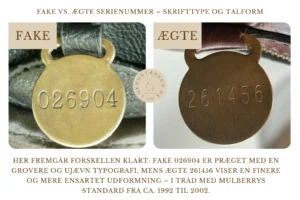
The appearance of the serial number quickly reveals whether it is real or fake. The characteristics are clear:

• Genuine serial numbers from this period have a thin engraving, executed in a uniform sans serif font without serifs – always with precise depth and a harmonious expression.

• Fake serial numbers often use fonts with serifs, uneven thickness or an unbalanced expression.

• Numbers such as 1, 2, 4, 6 and 9 with a small “hat” are typical signs of copies.

The example shows the difference very clearly:

FAKE 026904 appears rough, with uneven depth and an incorrect font, lacking the precision and balance that characterizes Mulberry.

GENUINE 261456, on the other hand, has a sharp, symmetrical and uniform engraving, completely in line with Mulberry’s standard for vintage bags produced in the period approx. 1992–2002.

Color and surface

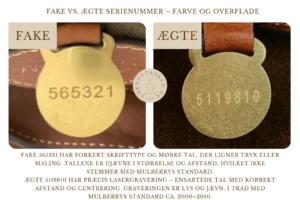
The engraving on a genuine Mulberry plate is always discreet and precise. The telltale signs are clear:

• Genuine Mulberry serial numbers are never printed with ink or paint – they are precisely engraved into the metal (vintage models up to around 2002) or laser engraved (from around 2002).

• Many replicas use black ink or paint, making the numbers appear unnaturally dark or “printed”.

• If the numbers can be scratched off or feel uneven, this is a clear warning sign.

• Counterfeit engravings can be rough, uneven in depth or have a dot matrix structure – a technique Mulberry has never used.

The example here shows the difference very clearly:

FAKE 565321 has the wrong font and dark numbers that appear as printing or paint on top of the metal. In addition, the numbers are uneven in both size and spacing, and the placement does not meet Mulberry’s standards.

GENUINE 5119810, on the other hand, shows precise laser engraving – the numbers are uniform in size, with correct spacing and centering. The engraving appears bright, even and fine, in line with Mulberry’s standard for the period approx. 2000–2010.

Placement and centering

A genuine serial number is always located exactly in the middle of the back of the metal plate – correctly centered and horizontally placed. This gives a balanced and symmetrical appearance.

• Genuine serial numbers are always centrally located, with equal distance to both the top and bottom of the plate.

• There is also no unnecessary empty space before the first or after the last number – the spacing is balanced and follows Mulberry’s standard.

• Regardless of the period the serial number originates from, you will always be able to see a harmonious distance between the numbers, which gives a clean and professional look.

• Copies often have numbers that are crooked, moved up/down or too far to one side.

• Too much space at the beginning or end of the number, or uneven air around the numbers, often reveals a copy.

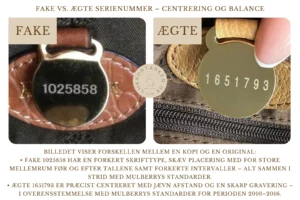
The example here clearly shows the difference:

FAKE 1025858 has an inharmonious placement: visible empty spaces before and after the number and an incorrect font with uneven distances between the numbers. All this gives an unbalanced impression and does not meet Mulberry’s standards.

GENUINE 1651793, on the other hand, shows correct centering with precise spacing, symmetry and no unnecessary space around the numbers. The engraving appears sharp and uniform – completely in line with Mulberry’s standard for the period approx. 2010–2016.

Reused numbers

Copies often share the same serial number – something Mulberry never does.

  • A serial number that appears on several different bags or models is a clear sign of a copy
  • Authentic Mulberry bags never have identical serial numbers – each bag has its own unique number
  • See examples in our overview of known “copy numbers” in section 4 Commonly used copy numbers on counterfeit Mulberry bags (2026)

Quick check: Signs of a fake Mulberry serial number

  • Use of black paint or paint
  • Incorrect or old-fashioned font
  • Numbers of different thickness or shape
  • Off-center placement or appear crooked
  • Shallow, spotty or uneven engraving
  • The number appears on many different bags

💡 Bonus tip: Use a magnifying glass or macro to examine the details – genuine engraving reveals its quality when magnified.

4. Commonly used replica numbers on counterfeit Mulberry bags (2026)

Reused serial numbers – a clear warning sign

One of the most reliable signs of a fake Mulberry bag with a metal disk is the use of a reused serial number – that is, the same number that appears on many different bags, models and colors. This is something Mulberry never does. Each genuine bag has its own, unique serial number.

If you see one of the numbers below – especially if the bag also has cheap hardware, imprecise logos or crooked stitching – it is a clear sign of a copy.


What is the list based on?

The list of known replicas is not based on guesswork or rumors – but on documented knowledge and professional experience. At luksustasker.dk we have:

  • Reviewed and documented over 1000 Mulberry bags – both genuine and counterfeit
  • Professional experience with authenticity assessment, including details such as serial numbers, engraving and placement
  • An active collaboration with international experts in the field of luxury goods authentication
  • Access to official reference materials and global databases, which help identify patterns in replicas
  • Ongoing monitoring of the second-hand market in 2026 – incl. online marketplaces, auctions and social media

How to use the list

Use the overview as a handy tool when you:

  • Considering buying a used Mulberry bag and want to check the serial number
  • Have a bag in your collection and want to make sure the number doesn’t appear on replicas
  • Want insight into how counterfeits are detected in practice

 💡 Important to know: Mulberry never reuses serial numbers.

The serial number is an important part of authentication, but should never stand alone. It should be assessed in conjunction with:

  • The materials and stitching of the bag
  • Precision of logo and hardware
  • Interior details and model knowledge

💡 Expert advice from luksustasker.dk  

At luksustasker.dk we evaluate each bag based on more than 30 details – not just the serial number. This includes:

  • Quality and type of leather or canvas (including different finishes and embossing)
  • Construction, stitching and joints
  • The bag’s logo – both precision, placement and font
  • Hardware and metal engravings, including locks, chains and buckles
  • Relationship with model, year of production and known variations
  • Inner lining, labels and any receipt traces
  • Wear and patina – how the bag ages can reveal its authenticity
  • Scent and the surface feel of the leather – an important indicator across both new and older models

You are always welcome to contact us if you would like more information about a specific bag available on our website.

How to identify an authentic Louis Vuitton bag – materials, logo, stitching and date codes

Louis Vuitton is one of the world’s most copied luxury brands. Therefore, it is crucial to be able to distinguish an authentic bag from a replica. Many fakes look convincing at first glance – but small details reveal the truth.

Here’s our professional guide on how to spot the difference.

This guide will help you identify the key signs of authenticity – and avoid copies that may at first glance resemble the real thing.

This guide is for informational purposes only and is based on publicly available information, industry sources, collector archives, authentication databases, applicable Industry Authentication Standards and years of experience with authentic Louis Vuitton bags.

In this guide, we will review:

  1. Materials – Canvas and Leather
  2. Stitching and Craftsmanship
  3. Hardware and Logo
  4. Date Codes and Production Codes
  5. Datacodes – Overview Factory codes
  6. Inner lining and labels
  7. Smell and fragrance
  8. Packaging and dustbag
  9. Typical signs of copies
  10. FAQ and practical checklist
  11. Conclusion – overall assessment is crucial
  12. Expert advice at luksustasker.dk

1. Materials – canvas and leather

Louis Vuitton uses both canvas and different types of leather in their collections. Here we review the most well-known materials and their characteristics.

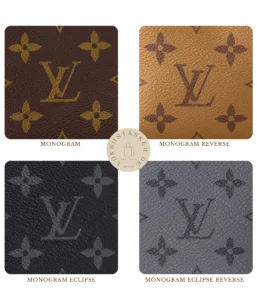
Monogram Canvas

Coated canvas (not leather) with the iconic LV print.

💡 Expert tip: Genuine Monogram canvas feels matte and firm – never plastic or shiny.


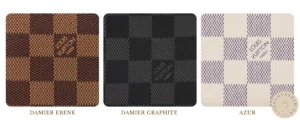
Damier Canvas

Checkered pattern in several versions: Ebene (brown), Azur (light, 2006) and Graphite (black/grey, 2008). There are also limited editions such as Damier Cobalt.

💡 Expert tip:On genuine Damier canvas, the colors are deep and the pattern is sharp, without blurring or uneven printing.


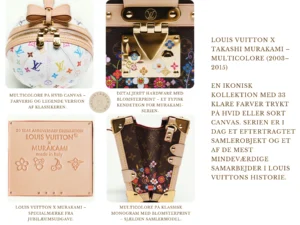
Monogram Multicolore (2003-2015)

A collaboration between Louis Vuitton and artist Takashi Murakami. 33 different colors printed on white or black canvas. The series is today sought after by collectors.

💡 Expert tip: Original Multicolore bags have bright colors and precise printing without smudging.


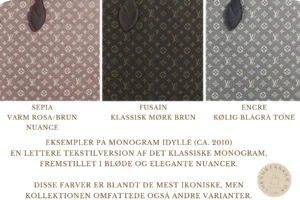
Monogram Idylle (ca. 2010)

A lighter textile version of Monogram, made in soft shades such as beige, pink and brown.

💡 Expert tip: The fabric feels firm, but not rough. Genuine models have precise stitching and clear logos.


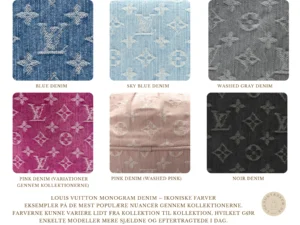
Monogram Denim (mid-2000s)

Monogram pattern printed on dyed denim in blue, green, pink, gray and black. Gives a bohemian and vintage look.

💡 Expert tip: Genuine Monogram Denim fades naturally with use – copies often appear too even in color.


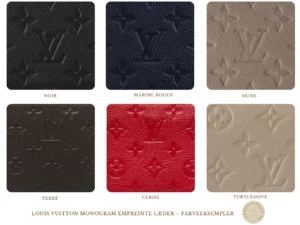
Empreinte leather

Soft calfskin with embossed monogram.

💡 Expert tip: Genuine Empreinte feels elastic and soft – the monogram stands out deep and precisely.


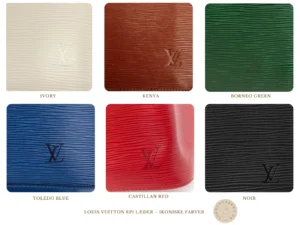
Epi leather (1985-)

Structured and scratch-resistant leather, often in strong colors.


💡 Expert tip: Original Epi leather has a distinct wavy structure and a discreet embossed LV logo in the lower corner.


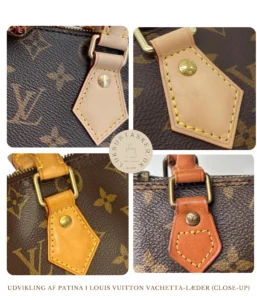
Vachetta leather

Natural, untreated leather that develops a patina over time.


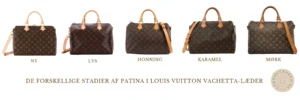
Vachetta leather – development of patina

New Vachetta

Very light, almost white/beige color, which stands in elegant contrast to the Monogram canvas.

Light patina

After a short period of use, the leather takes on a faint beige tone, sometimes with a slight pink tinge.

Honey patina

A warm golden hue that is highly prized by collectors. Marking a classic balance between new and used leather.

Caramel Patina

With further use, the leather develops a deeper amber or caramel color, giving the bag a rich and timeless look.

Dark Patina

With prolonged and frequent use, the leather will turn dark brown. Contact with hands, oil and lotion can intensify the process, especially on handles and zipper pulls.

💡 Expert tip: Genuine Vachetta leather always patinas over time – if the leather does not change, it is a warning sign.


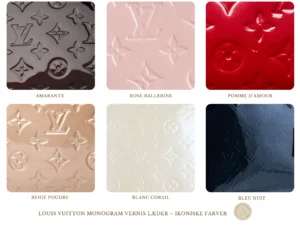
Vernis Leather

Patent leather with a glossy finish. Over time, it develops a slightly golden hue.

💡 Expert tip:Genuine Vernis has a mirror-like depth of color, but is sensitive to scratches and color transfer.


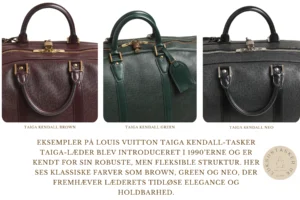
Taiga leather (1990s-)

Robust, structured leather used primarily in men’s collections.

💡 Expert tip: Genuine Taiga has a uniform, fine structure – robust, but still flexible.


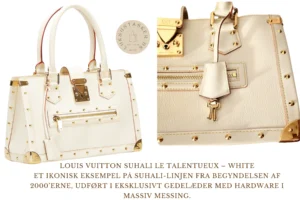
Suhali leather (early 2000s-)

Exclusive goat leather of the highest quality, produced in a few colors. Rare on the preloved market today.

💡 Expert tip: Suhali feels silky smooth with a matte finish – always with heavy stitching and solid brass hardware.


Taurillon leather

Soft, grained calfskin type, used in many newer models (e.g. Capucines).

💡 Expert tip: The surface is naturally grainy and uneven – copies are often too smooth.


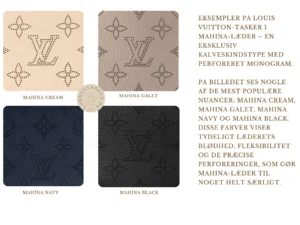
Mahina leather (2007-)

Exclusive calfskin with perforated Monogram, inspired by Polynesian culture.

💡 Expert thread: Genuine Mahina has precise perforations and extremely soft leather.

2. Stitching and craftsmanship

• The stitching is very precise and evenly placed.

• The number of stitches at the handles and edges is identical on both sides.

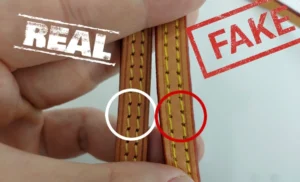
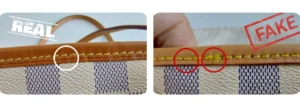
• Louis Vuitton is characterized by an even, lightly waxed, yellow/mustard yellow stitching; irregularities are a warning sign.

• Each stitch may be slightly slanted because many details are sewn by hand.

• Loose threads, unevenness or asymmetry often reveal copies.

💡 Ekspertråd: Forfalskninger bruger ofte for lyse, syntetiske tråde (orange/gul) og uden voks-agtig struktur.

3. Hardware and logo

• Original hardware is metal and feels solid; on newer models, the finish is typically a gold-colored coating, while some parts may be brass.

• The surface has a warm golden tone, not a mirror-like finish.

• Engravings should be deep, sharp, and centrally located.

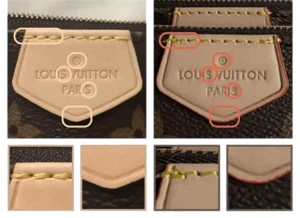
• Embossing/printing “Louis Vuitton Paris” should be sharp and even:

– The O appears round (not distinctly oval)

– The L has a short base

– The Ts are close together, but not touching

– The ® symbol is proportioned and correctly positioned in relation to the text

• The font is Louis Vuitton’s own; deviating letter shapes or spacing are a red flag.

Note (vintage): Patina is normal: darker padlocks, slightly faded zippers and possibly greenish oxidation on buttons.


4. Date codes and production codes

Historical development (overview):

• Before 1982: no date codes.

• 1982 – mid-1980s: 3–4 digits → year + month

– 821 = January 1982

– 8211 = November 1982

• Mid/late 1980s: 

3–4 digits + 2 letters (factory/country)

– 882VI = February 1988 (France)

– The code could be split: numbers in one place, letters in another

• 1990–2006: 2 letters + 4 digits

– 1st & 3rd digits = month; 2nd & 4th digits = year

– SA1004 = October 2004 (Italy)

• 2007 – March 2021: 2 letters + 4 digits

– 1st & 3rd digits = week; 2nd & 4th digit = year

– FL2131 = week 23, 2011 (USA)

As of 2021: LV has gradually moved away from visible codes in favor of NFC/RFID chips. Location and readability vary, and chip data is not always available to consumers.

Location (especially vintage):

• The code may be on a leather patch in an inner pocket or stamped close to a seam.

• On some vintage models, the code may be faintly visible, faded, or hidden deep in the bag – requiring careful inspection.

• Practical tip: search “[model name] + date code” for typical locations for your particular model.

Important: A correct date code does not prove authenticity in itself. Many copies use realistic/”borrowed” codes, and the codes are not unique.

5. Datacodes – Overview of Factory Codes

Overlapping Louis Vuitton factory codes – full explanation 

SD – France / USA

• Older models (before mid-1990s): most often France.

• Newer models (from mid-1990s onwards): most often USA (San Dimas, California).

• History: Started as a French code, but was adopted for American production during the 1990s.

• Typical use: Very common on canvas bags from the USA in the 1990s and 2000s.

• Check: Compare the date code with the “Made in …” stamp and other signs of authenticity (materials, stitching, hardware).

FL – France / USA

• Most common: France.

• History: Originally French code; also documented on bags from the USA, especially in the 1990s.

• Typical use: American series in the 1990s.

• Check: Compare the date code with the “Made in …” stamp and other signs of authenticity (materials, stitching, hardware).

SA – France / Italy

• Most common: France.

• History: Known as the French code in the 1990s on classic bags. Later also seen in Italy, especially on smaller leather goods.

• Typical use: Classic bags (France), wallets/belts (Italy).

• Check: Compare the date code with the “Made in …” stamp and other signs of authenticity (materials, stitching, hardware).

LA – France / USA

• Most common: USA (San Dimas, California).

• History: Occurred in France in the 1980s and early 1990s. From the late 1990s it is mainly seen in the USA.

• Typical use: Bags from the 1990s and early 2000s.

• Check: Compare the date code with the “Made in …” stamp and other signs of authenticity (materials, stitching, hardware).

LW – Spain / France

• Most common: Spain (Toledo).

• History: Used in Spain since the 1990s; a few cases documented in France, but without a fixed period.

• Typical use: Speedy and accessories produced in parallel in Spain and France.

• Check: Compare the date code with the “Made in …” stamp and other signs of authenticity (materials, stitching, hardware).

BC – Italy / Spain

• Most common: Italy.

• History: Used in Italy since the 1980s. In the 2000s also used in Spain in connection with production restructuring.

• Typical use: Often on SLG (wallets, cardholders).

• Check: Compare the date code with the “Made in …” stamp and other signs of authenticity (materials, stitching, hardware).


General check (applies to all of the above codes)

The letters in the date code should always match the “Made in …” stamp on the bag. If they do not match, it is a clear red flag.

Note

Louis Vuitton has never published an official list of factory codes.

The information presented here is based on well-documented observations and many years of experience with authentic bags. Variations may occur, and factory codes alone do not prove authenticity.

They should therefore always be assessed together with other authenticity criteria such as materials, stitching, hardware, lining and the “Made in …” stamp.

The dates for SA, LA, LW and BC are indicative, as there are no official dates for any changes between countries. The information is based on well-documented observations and many years of experience.


Want to know where and how Louis Vuitton bags are created – and what characterizes genuine craftsmanship?

Read our article with authentic examples of heat stamps, date codes and ‘‘Made in U.S.A. of imported materials’’ labels – including on models such as the Neverfull, Speedy and Pochette Métis.

Read the full guide

Made in France… or? Where are Louis Vuitton bags produced today? and learn more about Louis Vuitton’s production, authenticity and craftsmanship.

6. Interior lining and labels

• The lining is typically cotton, microfiber or Alcantara (depending on model/year).

• Leather label with embossing: “Louis Vuitton – Paris – Made in …”.

• Color and texture vary by model and production.

• Blurred, off-centered or irregular embossing is typical of copies.

💡 Expert tip: In Damier Ebene, red lining is the most common — but there are legitimate variants on selected models/years. Wrong or uncharacteristic lining types can be a warning sign.

7. Smell / fragrance

• Real LV often has a mild leather scent or almost no smell.

• Replicas often smell of glue, chemicals or plastic.

💡 Expert tip:The smell is an underestimated but effective indicator (especially on vintage).

8. Packaging and Dustbag

• Original boxes have a distinctive yellow/saptan tone with a sharp logo and quality handle/ribbon (design may vary over time).

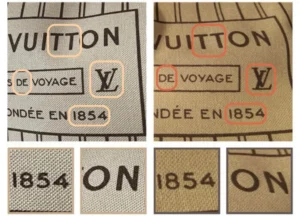
• Dustbags are cotton/canvas with correct LV logo and typography (design has changed over the years).

• No typos, smudged lines or poor print quality

💡 Expert tip: Packaging is also counterfeited — use it only as an additional sign, never as the only proof.

Note: Louis Vuitton does not issue authenticity cards.

9. Typical signs of copies

• Asymmetrical or crooked monogram/check.

• Too light or uneven stitching.

• Too shiny or light hardware/surface coating.

• Incorrect or copied date codes (inconsistent with other details).

• Spelling errors such as “Luis Vitton”.

• Artificial, uneven patina on Vachetta.

• Colors/patterns on models that LV never produced.

Tip: A price that is “too good to be true” is almost always a red flag.

10. FAQ & checklist

  • Do all LV bags have a date code?

    No. Vintage and models from 2021+ may not have it (due to chip).

  • Can I trust the receipt and dustbag?

    Partially. They are easy to copy and should not stand alone.

  • Does Louis Vuitton ever use plastic hardware?

    No. The hardware is metal.

  • Is it normal for the LV logo to be upside down?

    Yes, on models cut from a single piece of canvas (e.g. Speedy, Papillon, certain Keepalls).

11. Conclusion: Overall assessment is the key

Recognizing a genuine Louis Vuitton requires an eye for detail:

✔ Materials and stitching

✔ Fragrance and texture

✔ Hardware and logo

✔ Date code/ RFID

✔ Symmetry and typography


One correct detail is never enough — it is the sum that determines authenticity.

12. Our expertise at luksustasker.dk

At luksustasker.dk we assess each bag based on more than 30 authentication points — regardless of whether it is a Louis Vuitton or a Mulberry. We never look at just one element, but at the whole.

Common criteria we always examine

• Serial numbers and date codes — in conjunction with model, age and other details

• Materials and leather/canvas — texture, patina, embossing and surface feel

• Stitching and construction — stitch count, precision, symmetry and quality

• Logo and typography — font, placement and embossing/printing

• Hardware — weight, material, coating/oxidation and engravings

• Symmetry in pattern/print — monogram, check or embossed pattern must be precise and mirrored

• Stamps and labels — clarity, depth and correct placement

• Interior details — lining, labels and finish

• Wear and patina — natural aging of leather and metal

• Smell and surface — important indicator, especially on vintage

• Consistency with reference examples — comparison with original archives and documented models

 At luksustasker.dk we use magnifying glasses, UV light and access to reference archives to ensure the most accurate assessment.

You are always welcome to contact us for professional advice or more information about a specific bag on our website.

 Ready to find your next genuine Louis Vuitton?

Explore our hand-picked selection of pre-loved Louis Vuitton bags — all verified for authenticity and described with transparency and expertise.

• Are you looking for a specific model — or help choosing?

• We offer personal advice and professional insight so you can shop confidently and well-informed.

Explore the full range here: luksustasker.dk/shop

Or contact us directly — we’re ready to help you.

How to identify an authentic Mulberry bag – key details, serial numbers and materials

Is your Mulberry bag real? This question has become increasingly relevant as both vintage and pre-loved Mulberry bags have increased in popularity – and unfortunately, also in the number of fakes.

Models like the Bayswater, Alexa and Antony are among the most iconic and sought-after – and at the same time some of the most copied. Today, however, almost all Mulberry bags are imitated, regardless of year, size or model. That is why it is more important than ever to be able to distinguish between authentic craftsmanship and mass-produced copies.

In this guide you will find thorough and practical advice on how to assess the authenticity of a bag yourself – regardless of whether you are considering buying vintage, pre-loved or are just curious.

This guide is for informational purposes only and is based on publicly available information, industry sources, collector archives, authentication databases, applicable Industry Authentication Standards and many years of experience with authentic Mulberry bags.

In this guide, we will review:

1. Leather types: modern and vintage

2. Hardware: zippers, straps and Postman’s Lock

3. Stitching and edging: precision and craftsmanship

4. What types of lining and interior details characterize a genuine Mulberry bag

5. How to recognize the branding and logo on a genuine Mulberry bag – embossing and printing

6. The metal disc and the serial number

7. Where is the bag made? – and what does the label reveal?

8. Final advice: What should you always check when assessing the authenticity of a Mulberry bag?


1. Leather types: modern and vintage

Mulberry is known for its uncompromising leather quality. Whether you’re holding a new or vintage bag in your hand, the genuine leather will always be full of character, vibrant and durable. In this section, we review the most important leather types – both modern and classic – and show you what to look for to recognize authenticity.

 

Modern leather types from Mulberry (approx. 2015–2025)

Used in today’s collections – focus on durability, texture and a luxurious feel:

  • Classic Grain – Textured, scratch-resistant cowhide with a matte surface. Very durable and suitable for everyday use.
  • Small Classic Grain – Finer version of Classic Grain with more uniform grain.
  • Heavy Grain – Coarse-grained, stronger structure. Gives a more raw, masculine look.
  • Natural Vegetable Tanned (NVT) – Smooth, untreated cowhide that develops a natural patina over time.
  • Silky Calf – Very smooth and soft calfskin with a slight sheen. Elegant and exclusive.
  • Smooth / Box Calf – Uniform and minimalist leather with a slight shine. Classic and modern expression.
  • Velvet Calf – Lightly brushed calfskin with a velvety surface and discreet shine.
  • Croc Embossed Leather – Embossed calf or cowhide with a crocodile structure. Elegant and structured.
  • Patent Leather – Patented, high-gloss leather. Rarely used in newer collections.
  • Suede – Soft and matte leather with a vibrant texture. Delicate and requires impregnation.
  • Nubuck – Finer and more polished than suede – very soft, but also delicate.
  • Goatskin – Light and durable with a fine grain structure and natural shine.
  • Ox Leather – Strong and shape-retaining leather from adult oxen. Often used as a base in Classic Grain and NVT.
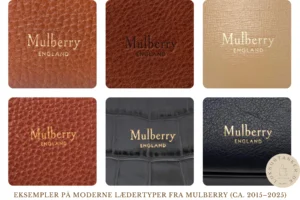
💡 Expert tip: Genuine Mulberry leather feels natural and vibrant – fake bags often have a plasticky finish, a strong chemical smell or unnatural stiffness.

Did you know?

Mulberry was founded in 1971 in Somerset, England – initially focusing on belts and small leather goods. It wasn’t until the 1980s that the brand really started producing the bags that are now considered iconic. Here, materials such as Darwin leather, Congo and Buffalo became a central part of Mulberry’s aesthetic and heritage.

These leathers are not only beautiful and durable – they also tell the story of a British brand with deep roots in traditional craftsmanship.

Vintage leathers from Mulberry (c. 1980–2010)

Used in older collections – known for their character, durability and beautiful patina.

Since its founding in 1971, Mulberry has been synonymous with classic British leather craftsmanship. The older leathers from the brand’s earlier decades have achieved iconic status among collectors and connoisseurs. They are characterized by their authentic expression, natural aging and impressive durability – and many vintage bags only become more beautiful with time.
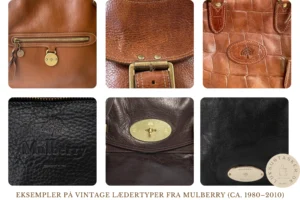
 

Each leather type tells its own story and contributes to the bag’s unique expression.

  • Vintage leather types from Mulberry (approx. 1980–2010)

Used in older collections – known for their character, durability and beautiful patina:

  • Darwin Leather – Thick, vegetable tanned cowhide with raw, waxed surface. Develops a warm glow and patina with use.
  • Vintage NVT – Untreated leather with a matte surface, which darkens and gains depth over time. Delicate at first, but develops beautifully.
  • Croc Embossed NVT – Vegetable tanned leather with deep crocodile embossing and matte finish. Typical of attaché cases and doctor bags from the 80s.
  • Antique Glacé Leather – Smooth calfskin with a natural shine from wax treatment (not varnish). Aged with a play of colors and a vintage look.
  • Scotchgrain Leather – Coarse-grained, embossed and often coated leather. Extremely durable and suitable for travel bags and weekend bags.
  • Buffalo Leather – Strong, coarsely textured leather with natural folds and an uneven surface. Very robust and dimensionally stable.
  • Glove Leather – Very soft and flexible calfskin without a clear structure. Used in small bags and vintage clutches.
  • Saddle Leather – Thick and stiff leather inspired by saddlery craftsmanship. Patinas darker and becomes more shiny with age.
  • Pebbled Calf (early) – Early version of embossed calfskin with live grain and soft structure.
  • Raw Hide / Rustic Leather – Minimally treated cowhide with natural color variations. Develops a unique, dramatic patina over time.

Summary: How to recognize genuine vintage Mulberry leather

Genuine vintage Mulberry leather:

  • Has a natural texture, authentic patina and distinct character
  • Develops beautifully over time and ages gracefully
  • Feels solid and vibrant – and smells like genuine, untreated leather (never chemically)

Fake or low-quality leathers:

  • Often appear flat, stiff or unnaturally smooth
  • Lack depth and do not age with the same aesthetics
  • Often have an artificial, sour or plastic smell

💡 Expert advice:Use your senses when evaluating a vintage Mulberry bag. Feel the texture of the leather, smell the material and study the patina – authenticity can be felt, not just seen.

Read more in our blog post: Care of Mulberry bags – how to keep leather beautiful for many years

2. Hardware: zippers, Postman’s Lock, buckles and straps

When assessing the authenticity of a Mulberry bag, metal fittings and straps are among the most revealing details. The Postman’s Lock in particular – one of the brand’s most iconic elements – can quickly reveal whether it is original craftsmanship or a copy.

Zippers – development and authenticity

The zipper is one of those details that is often overlooked – but it can tell a lot about both the age and authenticity of the bag. Over the years, Mulberry has used different types of zippers, and their development reflects changes in both design and production methods:
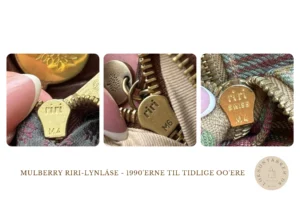
  • 1990s – early 00s: Many vintage models have Riri zippers, which are known for their durability and high quality. This is a clear characteristic of older, genuine bags.
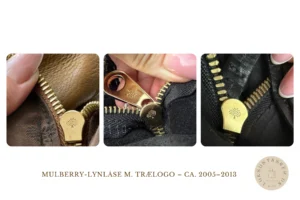
  • Around 2005–2013: Mulberry started using its own zipper pullers with an embossed tree logo with leaves on the back. This iconic symbol is a clear and authentic detail for bags from the period.
  • After 2016: Many newer models have zippers without engraving. These are still original and selected with a focus on function and aesthetics. The zipper should slide smoothly and feel solid in use.


Important to know: The absence of a logo on the zipper is not necessarily a sign of a replica. At Mulberry, it is normal for modern zippers to be unsigned – especially in newer collections.

Typical signs of replicas:

  • Zippers with uneven or stiff movement
  • Incorrect or too deep engravings
  • Lightweight metal that feels hollow or is peeling
  • Uneven color or finish compared to the rest of the hardware

Postman’s Lock – classic Mulberry detail

This locking mechanism is seen on many of Mulberry’s most popular models such as the Bayswater, Alexa and Lily. A genuine Postman’s Lock is made of heavy, solid metal with a smooth finish and precise engraving.

Engraving comes in two variants – depending on model and year:
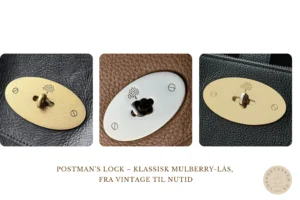
  • Older models typically have an embossed wooden logo (the classic Mulberry symbol).
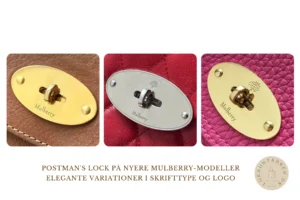
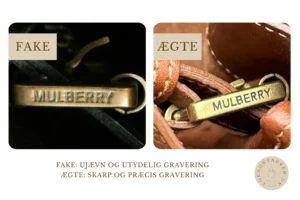
  • On newer models, “Mulberry” may be embossed on the hardware – especially on the Postman’s Lock – in a thin and elegant font, both with and without the wooden logo, depending on the model and year of manufacture.

Both versions should be sharp, centered and harmoniously placed.

The wooden logo should reflect the brand’s official design:

  • Pointed leaves in the correct number and direction
  • A clear, symmetrical and well-balanced shape

Errors in the placement, font or level of detail of the engraving are often signs of a copy.

Typical signs of copies:

  • The lock feels light and uneven in the surface
  • The engraving is blurred, crooked or completely absent
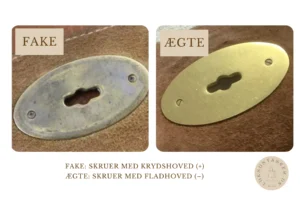
  • The screws on the back have industrial “+” shaped head, not used by Mulberry
  • Unoriginal color tone in the metal or visible casting marks
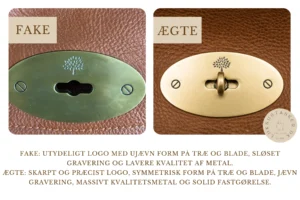
Note: A clear sign of copies – screws with a cross head (+)

One of the most obvious signs of fake Mulberry bags is the use of screws with a cross head (+) on the back of the lock – a detail often seen on low-quality copies.

  • Genuine Mulberry bags use only small, straight screws with a flat head (-), which are precisely and discreetly placed
  • The shape and quality of the screws is an important indicator when assessing the authenticity of the hardware and finish

Therefore, always pay attention to the type of screws – it’s a small detail, but often enough to reveal a copy.

Buckles – function and authenticity

Adjustable buckles on genuine Mulberry bags combine functionality with elegant design and solid construction.

Characteristics of original buckles:

  • Made of heavy metal with uniform color and finish
  • Robust – not hollow or light
  • May be embossed with Mulberry logo (not a requirement for all models)
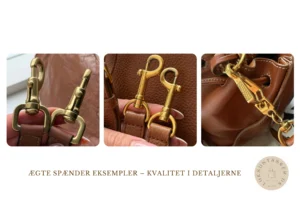
Typical signs of copies:

  • Lightweight metal or painted surface that is peeling off
  • Crooked or poorly mounted buckles
  • Lack of symmetry in the joints

Straps – leather, stitching and finish

Authentic Mulberry straps reveal the brand’s attention to detail and quality craftsmanship.

💡 Expert advice: What to look for:

  • The leather is precisely cut and has even, smooth edge sealing
  • The stitching is tight, straight and free of loose threads
  • The joints between the strap, buckle and bag are symmetrical and clean
  • The color matches the rest of the bag’s leather and finish

Typical signs of copies:

  • Glued ends instead of sewn
  • Uneven cutting, frayed edges or sloppy coating
  • Light metal that does not match the other hardware of the bag
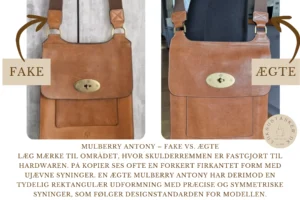
Mulberry Antony – fake vs. genuine

One of the most striking external characteristics of a fake Mulberry Antony compared to a genuine model is the area where the shoulder strap is attached to the hardware.

There are of course other external “red flags” – for example, the quality of the leather, the hardware or the color shade of the shoulder strap.

In this section, however, we will focus specifically on the strap – stitching and finish – and will therefore examine this detail in more detail.

• On the replica, the shape is often square, and the stitching forms a distinctive cross. This gives an unprofessional look, and the stitches often appear uneven or asymmetrical. The assembly is usually less precise and can appear “clumsy” in relation to the other proportions of the bag. The reason is that replica manufacturers choose a simpler and cheaper sewing technique rather than the method used by Mulberry.

• On a genuine Mulberry Antony, the design is consistently rectangular. The clasp is longer than it is wide, and the stitching is tight, symmetrical and precise. No cross or crooked stitches – everything is done to Mulberry’s exacting standards of craftsmanship. This detail supports both the strength of the construction and the harmonious aesthetics of the bag.

When compared side by side, the difference is clear: square shape with cross stitching = replica, rectangular shape with straight, precise stitching = genuine.

💡 Final advice

When evaluating a Mulberry bag, take the time to inspect the transition between leather and hardware – this is often where the biggest difference between genuine quality and mass production becomes apparent. A well-made Postman’s Lock, solidly mounted buckles and precisely executed straps are strong indicators of authenticity.

You can read more about the details you should always pay attention to in this blog’s point 6: “Final advice – What should you always check when assessing the authenticity of a Mulberry bag?”

3. Stitching and edges: precision and craftsmanship

When assessing a Mulberry bag, stitching and edge finish are some of the most revealing details. They testify to genuine craftsmanship – or lack thereof. Authentic Mulberry bags are characterized by a high degree of precision and consistent quality throughout the entire construction.

Stitching:

  • The stitching is always straight, tight and symmetrical – with uniform thread length and depth in each stitch
  • Strong and color-coordinated thread is used, which either matches the color of the leather or creates a stylish contrast
  • Copies often have uneven stitches, loose threads, asymmetry or cheap thread that quickly wears out
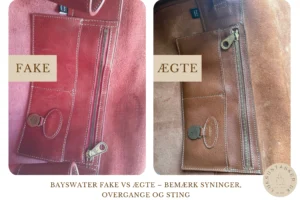
Finishings and reinforcements:

On genuine models, each stitching is finished with discreet backstitching – a technique that reinforces without compromising the aesthetic expression.

  • The finishings are symmetrical, precise and integrated into the design
  • Copies often have clumsy or messy finishes – with overlapping thread, uneven reinforcement or loose stitching
  • In many fake bags, the stitching is “improved” with extra thread or visible knots, which spoils the overall look

Edge coating

Mulberry uses a uniform and smooth edge finish on straps, flaps and edges – both for aesthetics and to protect the leather from moisture and wear.

  • The coating is applied evenly and follows the contours of the leather
  • Wear over time is normal – especially with intensive use – but the finish should never peel off in flakes
  • On copies, the edge treatment may appear imprecise with uneven thickness or application that does not follow the leather’s lines.
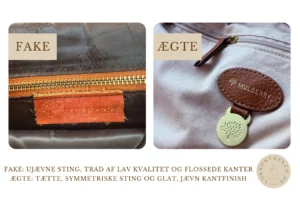
💡 Expert tip: The stitching is among the most reliable indicators of authenticity. Even when a bag looks correct at first glance, uneven stitching, asymmetry or loose threads will often reveal that it is a copy. In genuine Mulberry bags, precision and craftsmanship are evident in every stitch.

4. What types of lining are used in genuine Mulberry bags?

Over the years, Mulberry has used different types of lining depending on the model, collection and period. The choice of lining is not only a practical solution, but also an important part of the bag’s aesthetics and authenticity.

  • Suede / untreated leather lining – One of the most iconic solutions is the untreated back of the leather – a natural and robust form of raw lining, which is especially seen in classic models such as the Bayswater. Here there is no separate textile lining, but instead the dense and strong suede-like back of the skin, which gives the bag an authentic and honest expression. This type of lining is repeated in several other Mulberry models and is part of the brand’s characteristic craftsmanship. It adds a special charm, because you can both feel and see the quality of the leather itself from the inside. Over time, it develops a beautiful patina, which supports the bag’s vintage feel.
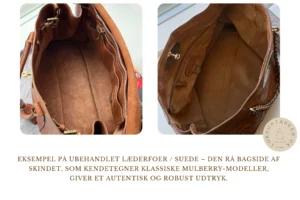
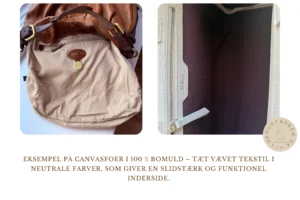
  • 100% cotton canvas lining – One of the most common lining types at Mulberry, used in both vintage and newer bags. It is characterized by a dense and durable weave, which makes it both durable and practical in daily use. The colors are often neutral and classic – they discreetly match the leather and the bag’s outer design. The canvas lining is also easy to clean and therefore a functional solution, especially in everyday and travel bags.
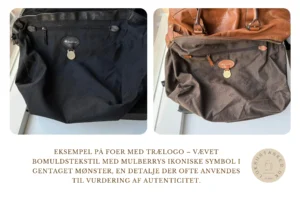
  • Lining with Mulberry logo (the tree) is primarily found in vintage collections and a few limited editions. In the newer collections from 2025, for example, you can see it in the Small Roxanne model, which is considered a timeless classic. Among vintage bags, Alexa is a clear example.

    The lining is made of cotton fabric with a discreet, repeated pattern of Mulberry’s iconic tree symbol. This gives the bag a more refined and luxurious look and at the same time acts as a subtle brand identity that emphasizes the connection to Mulberry’s heritage.

    For collectors and experienced buyers, the logo lining is not only a decorative detail, but also an important element in assessing the authenticity of the bag.
  • Jacquard tree logo lining – a classic and modern hallmark

    In the 1990s and 2000s, Mulberry used an exclusive jacquard-woven lining, where the brand’s iconic tree symbol is repeated in a uniform pattern. However, this type of lining is also found in some newer models and collections. It is made of a dense, heavy cotton with a robust texture, which gives the bag a durable and luxurious look.

    The jacquard weave both provides a refined look and acts as a subtle brand marker, supporting the connection to Mulberry’s heritage. For collectors and experienced buyers, the precision and detail of the pattern are an important indicator of authenticity. On genuine bags, the wooden logos appear clear and sharply defined, while on replicas they are often crooked, indistinct or far too large, and the fabric appears thinner and cheaper.
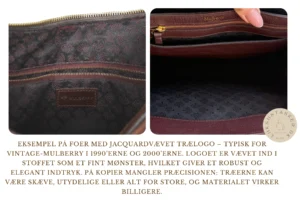
  • Microfiber lining – A modern solution, especially found in newer models like Lily. The microfiber is soft, lightweight and resistant to wear, making it a practical alternative to both canvas and leather. It feels luxurious to the touch and gives a more modern, minimalist impression of the bag’s interior. At the same time, it reduces weight and makes the bag more comfortable to use in everyday life. Since microfiber requires a more advanced production process than classic cotton canvas, it is considered a more expensive and exclusive solution. Therefore, it is often used in newer and more luxurious models, where Mulberry wants to combine functionality, lightness and an elegant expression.
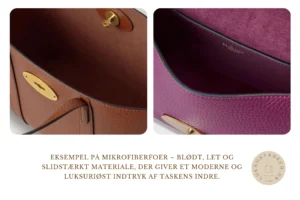
  • Checkered lining (tartan) – one of Mulberry’s most distinctive features in the 1980s and 1990s. The lining typically has subdued, earthy colors that reflect the design style of the time, and its pattern makes it less vulnerable to visible signs of wear compared to solid-colored linings. Some newer models still use tartan lining, but in a modernized version with clearer contrasts and more vibrant colors – a fresh expression that also provides a clear reference to Mulberry’s vintage roots. For many collectors and buyers, the pattern and quality of the tartan lining are valued as an expression of both the brand’s roots and its special charisma.
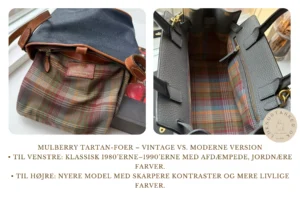
  • Leather lining – seen in selected luxury models and limited editions, where the inside of the bag is fully lined with genuine leather instead of textile. This solution gives an exclusive and uniform expression, where both the exterior and interior appear to be of the same quality. Leather lining is more durable than cotton or suede while also supporting the structure of the bag. Since leather lining is only found in specific models and periods, it is considered a rare and clear indicator of the authenticity of the bag – and a sought-after characteristic among collectors and buyers. At the same time, it provides a softer and more luxurious feel in use, which can rarely be reproduced in replica models.

What all these materials have in common is that they are carefully selected and adapted to the design and function of the individual bag.

What do real lining and stitching look like?

Interior details are characterized by precision and quality:

  • The lining fits tightly and correctly – without folds, unevenness or sagging
  • The stitching is symmetrical, even and free of loose threads
  • Pockets, labels and stitching placement are adapted to both the model and the leather type
  • Edges and finishes are clean and professionally done

💡 Expert tip: Check how the lining is attached to the sides of the bag – genuine Mulberry bags never have visible glue residue, loose corners or uncoordinated stitches.

Fake bags: typical signs in the lining

On many copies, the interior quickly reveals low quality:

  • Polyester lining that is shiny, synthetic or thin
  • Flaws in the pattern – for example, a tree logo that is crooked, unclear or too large
  • Asymmetrical stitching, loose threads and poorly placed labels
  • Missing functional details that are otherwise typical for the model in question
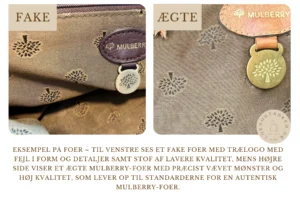
Summary

The inside of a genuine Mulberry bag reflects the same level of craftsmanship as the outside. Materials such as dense cotton canvas, raw suede and textile with a wooden logo are used consistently – and in high quality. The interplay between precision, structure and fabric choice is one of the clearest indicators of authenticity.

5. How to recognize the branding and logo on a genuine Mulberry bag – embossing and printing

The internal branding stamp is one of the most crucial characteristics when assessing the authenticity of a Mulberry bag. Over the years, Mulberry has used two different and original methods: heat stamp with color and printed logo.

The location, font and design can vary depending on the type of leather, collection and year of production – which is why it is important to know the small details that distinguish a genuine bag from a copy.

In this section, we show the authentic variants, how they appear on original models, and what typical errors are often seen on counterfeits.

Two authentic methods

Mulberry’s branding comes in two variants, each with its own characteristics:

1. Heat stamp with color (heat stamp + ink)

Here, the embossing itself is combined with a thin layer of special paint, which gives the logo more contrast and durability.

It is important that the contours appear sharp and that the color lies evenly without flowing with the structure of the leather. The leaves in the tree logo must be symmetrical and clearly defined, while the letters in Mulberry must be uniform and precisely placed. The method is used on both older and newer collections, especially where extra visibility is desired.
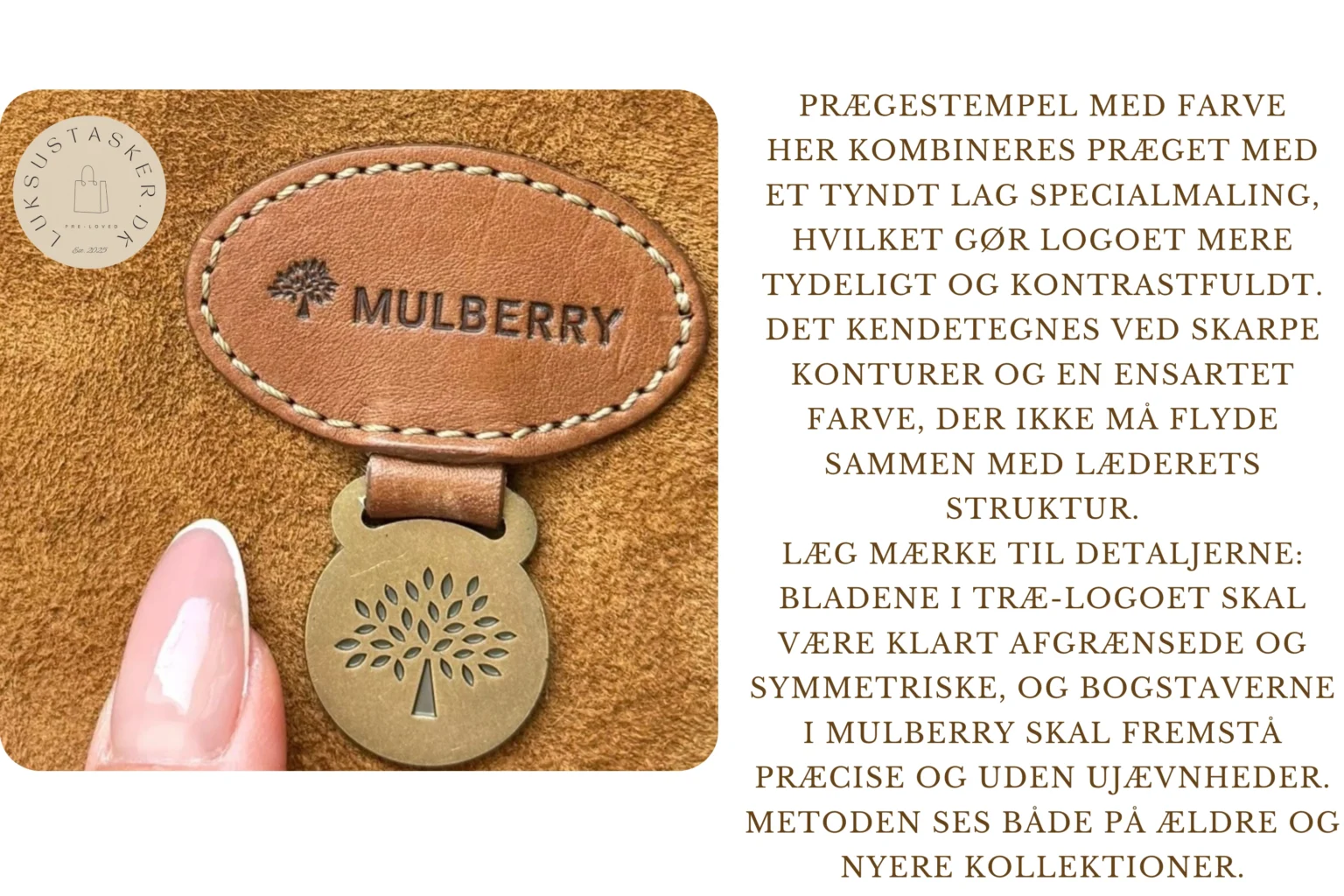
2. Printed logo (print stamp)

Here the logo is applied directly to the leather with paint, often in gold or silver. It provides high contrast and is the most common method, found on many both vintage and modern models.

A genuine print stamp is always smooth and precise: the letters are correctly spaced with a thin font, and the leaves in the tree logo are clearly defined. Uneven lines, blurred paint or too bold letters are clear signs of a copy.
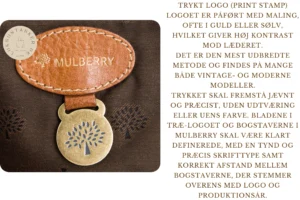
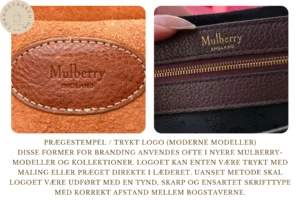
💡The method varies depending on the model and period, but the result on a genuine Mulberry bag is always the same: a sharp, uniform and professionally executed logo. Small details like the shape of the leaf, the spacing of the letters and the precision of the embossing are crucial in distinguishing originals from copies.

External logo and font – modern vs. vintage 

The font and location of the logo on the outside of the bag varies depending on the model and period. Not all bags have a visible external logo, but it appears in both newer and older collections.

  • Modern Mulberry bags

If the bag has an external brand print, the font always follows the brand’s official standards. The font is thin, sans serif, with correct letter spacing, reflecting Mulberry’s current visual identity.

The logo can appear alone as “Mulberry” or in combination with “Mulberry England”.

The placement is centered, harmonious and uniform in both line and embossing depth.

In newer collections, two different methods are used to apply the logo:
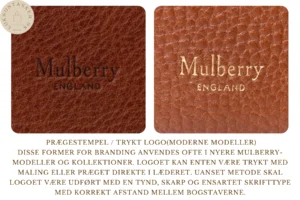
1. Embossing stamp without color (classic heat stamp)

The logo is pressed directly into the leather without the use of color. The result is a matte and discreet impression that follows the natural structure of the leather.

A characteristic is that the font appears thin and precise with correct letter spacing. On genuine bags, the print never appears uneven or unclear.

2. Printed logo (print stamp)

Here, the logo is applied to the surface of the leather with color, typically in gold or silver. The method provides a clear contrast and is used on both newer and older models – as mentioned above in connection with external brand printing.

A genuine printed logo always appears sharp and precise: the letters have the correct spacing, the font is thin, and the leaves in the tree logo are clearly defined. Uneven lines, blurred color or letters that are too bold are typical signs of a copy.

Depending on the type of leather, there may also be a slight embossed imprint under the color to ensure better readability of the brand name.


  • Vintage models (1990s – early 00s)

If a vintage model has an external logo, the font is always elegant, narrow with serifs and thin in design.
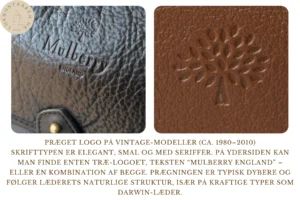
On the outside of a vintage bag, you can find some Sometimes you will see either a separate tree logo or the text “Mulberry England”. There are also models where both the tree logo and the text “Mulberry England” are present together, as shown in the picture on the left.

The embossing is usually deeper and follows the natural structure of the leather, especially on heavy leathers such as Darwin leather.

💡 Expert tip: Over the past 45 years, Mulberry has only made minimal changes to the tree logo, the font and the branding methods. They all have one thing in common: quality is in the details. The design of a bag must always match the model, the type of leather and the specific edition from the year in question.

Typical errors in copies

Typical errors in copies of Mulberry branding (name and tree logo)

Fake Mulberry bags often feature:

• Wrong font – too thick, with serifs or uneven spacing between letters

• Uneven embossing – too deep, blurry or crooked

• Wrong placement – ​​the stamp is crooked, off-center or the name is too large

• Low-quality paint – logos that smear or extend beyond the edges

• Wrong tree logo – leaves that are asymmetrical, irregularly placed or do not meet Mulberry standards for the period

💡 Expert tip: Authentic branding on a Mulberry bag is not just a name – it is a sign of thoughtful design and quality craftsmanship. Whether the logo is embossed or printed, it should always be executed with precision and style. Even small errors in font, placement or finish can be important indicators that the bag is not authentic.

6. The metal disk and the serial number

What does a real metal disk look like – and what does the serial number reveal?

Mulberry’s characteristic round metal disk has been a hallmark of the brand’s bags for many years. It serves not only as an aesthetic detail, but also as an important indicator of authenticity – especially in combination with the serial number on the back.

Front: The iconic tree logo

On genuine bags, the disk is:

  • Embossed with Mulberry’s distinctive wooden logo – each leaf shape must be clear, symmetrical and correctly oriented
  • Perfectly round and made of solid metal with noticeable weight
  • Sharp and harmoniously centered in the embossing
  • On certain vintage models, text such as “Mulberry Co.”, “Mulberry Company” or “Mulberry England” can also be seen around the logo

💡 A blurred logo, crooked placement or soft, indistinct leaves are a clear sign of a copy.

Back: Serial number

On the back of the metal plate, you will usually find an engraved serial number – a key factor in assessing authenticity.

• On vintage models (before 2000), the serial number was often embossed as a thin engraving directly into the metal – without any color filling.
• From the 2000s onwards, Mulberry began using machine-debossed/laser-engraved serial numbers with a clear white finish.

A genuine serial number is also characterised by:
• Clear, precise and uniform engraving in sans-serif font
• Correct centering on the plate
• Unique number for each bag

💡 A painted, black, illegible or misspelled serial number is a sure sign of a copy.

Known copy numbers

To make it easier to spot fakes, we have compiled a list of 25 of the most common fake serial numbers that are often used on copy bags. If you see one of these numbers on a bag, it is a fake. At Mulberry, each serial number is unique and can never appear on more than one bag.
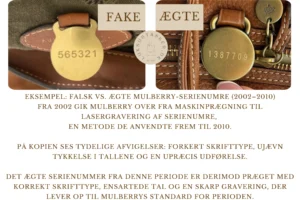
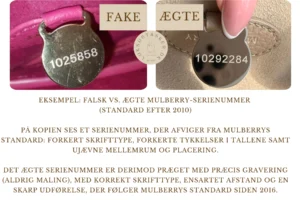
Typical examples of fake serial numbers:

254571, 026904, 565321, 262541, 258798, 275288, 257528, 373140, 258668, 025869, 932351, 166757, 924565, 249328, 982573, 346352, 207542, 1025858, 757156, 256678, 390207, 256760, 240535, 929976, 929885

🔍 Full list and visual examples can be found in our blog post: What does a genuine Mulberry serial number look like – and which numbers are typically used on replicas?

💡Important historical aspect

Mulberry began adding metal discs to select bags from the 1990s. During this transitional period, however, many models did not have serial numbers – only the wooden logo on the front. This is completely normal for vintage bags and not in itself a sign of a copy.

Modern exceptions – not all bags have a metal disc

Since 2016, Mulberry has gradually removed the classic metal plate with the serial number on a number of new models. This is part of the brand’s rebranding under Johnny Coca and Thierry Andretta, which introduced a more minimalist and modern look.

Models without a metal plate (fully or partially):

• Softie

• Iris

• Portobello

• Amberley

• Lily (some newer versions)

• Other collections with softer silhouettes

This phasing out of sheet metal has been gradual and has spanned almost a decade. In 2025, only two models with a metal plate and serial number can still be found on Mulberry’s official website: the classic Bayswater and certain versions of the Lily.

• On the Lily Medium, the metal plate is available in all colors.

• On the Lily in the classic size, the plate is only preserved in the basic colors.

• New seasonal colors such as Orchid Bloom Heavy Grain, Brighton Blue Heavy Grain and Chalk Heavy Grain are already produced without a plate – as part of the rebranding.

The decision was driven by several factors: the desire for a more minimalist and modern look, reducing weight and wear on the leather, and the fact that the metal plate was increasingly copied by counterfeiters and therefore lost its value as a marker of authenticity. Instead, Mulberry chose to enhance the overall look through materials, stitching, and hardware, which better reflects the brand’s contemporary luxury aesthetic.

💡 The absence of a metal plate or serial number is not a sign of a copy, as long as the bag otherwise complies with Mulberry’s official standards.

7. Where is the bag made? – and what does the label reveal?

Mulberry still produces many bags in Somerset, England, but over the years, production has also taken place in other countries:

• England

• Turkey

• China

• Italy

• Vietnam

• Spain (only on older/vintage models – bags are no longer produced here)


💡 Expert tip: Pay attention to the letter “g” in “England”

When assessing the authenticity of a Mulberry bag marked “Made in England”, it is important to take a closer look at the font – especially the letter “g” in the word “England”.
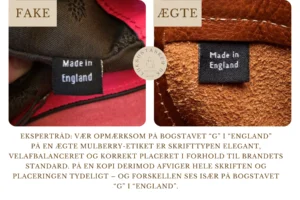
  • On a genuine bag, the font will be elegant and well-balanced, with a characteristic and complete design of the letter “g”.
  • On the other hand, if you see a label where “g” differs significantly – as shown in our example with a non-authentic label – we can safely say that the bag is a copy.

This detail is often overlooked, but the typography in particular reveals a lot about authenticity. At luxurybags.co.uk we have many years of experience in identifying these differences, and we are happy to share our knowledge to help you avoid buying the wrong thing.

Important: A genuine Mulberry bag may well have been manufactured outside of England. Especially newer collections and certain vintage models were produced in other countries – this is not in itself a sign of a copy.

Typical labels

Since approx. Since 1990, genuine Mulberry bags have had a production code on the back of the label, indicating the country of manufacture.

Front of the label: “Made in [country: England, Turkey, China, Spain, Italy, Vietnam]” – indicates the country where the bag was made.

Back of the label: Indicates the production code.
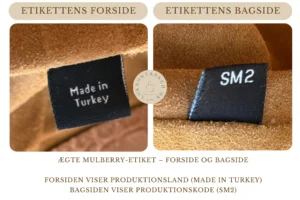
• The production code can consist of:

– one letter (e.g. Q)

– two letters (e.g. VY)

– three letters (e.g. REI)

– one letter and one number (e.g. C1)

– two letters and one number (e.g. MW6)

Why are production codes used?

• They allow Mulberry to identify the exact production location and batch.

• They are used internally for traceability and quality control.

• They contribute to transparency and support a consistently high quality in production.

• For experienced experts – like at Luksustasker.dk – the codes act as an additional check for authentication. A code must match the model, time period and country of production.

• Inconsistencies in the codes are often a clear sign of copies, even when other details may seem correct.

 💡 Expert advice: The production code is an important clue in authentication, but can never stand alone. It should always be evaluated together with other factors such as leather, stitching, hardware, logo and the metallic disc (medal), if the bag has one.

 💡 Expert tip:If the back of the black label with “Made in …” has the letter “X”, it is a sign of a copy – Mulberry never uses “X” in their authentic production codes.
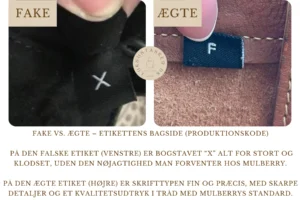
Vintage variants without textile label

Some older models have no textile label at all. Instead, the Mulberry logo and the text “Made in England” are embossed directly into the leather on an inner leather flap. This is especially seen on bags from the 1980s and early 1990s and is completely normal for these vintages.

Read more in our blog post: Are all Mulberry bags “Made in England”? – and why it’s not always the case

8. Final advice: What should you always check when assessing the authenticity of a Mulberry bag?

A serial number is an important element in authenticating a Mulberry bag – but it should never stand alone. A true assessment requires looking at the overall look and feel of the bag. Here are the most important factors you should consider in combination:

  • Leather type and texture

Is the leather consistent with the type Mulberry used on that particular model and vintage? Examples:

  • Darwin leather in vintage Bayswater bags
  • Classic Grain in newer models
  • Silky Calf on smooth, elegant bags

💡 Expert advice: The leather should have a natural texture, patina and glow – not appear plasticky, flat or smell chemical.

  • The construction and finish of the bag
  • The stitching should be straight, tight and symmetrical
  • The edges should be cleanly processed and sealed
  • No loose threads, uneven stitches or asymmetry

Poor craftsmanship often reveals copies – even when the materials seem genuine at first glance. 

  • Logo and branding
  • The wooden logo (on metal disc or embossing stamp) must be sharp and identical to Mulberry’s official design
  • The font must be correct: not too bold, no serifs, and with precise spacing
  • The embossing or printing must be smooth and clear

You can read more about the details you should always pay attention to in this blog’s point 5: “How to recognize the branding and logo on a real Mulberry bag” – here we go through in detail the typical characteristics of real Mulberry logos, including location, font, shape of the tree symbol and common mistakes on copies. 

  • Metal details and hardware
  • Zippers must be from approved suppliers – for example Riri or Mulberry’s own with an embossed tree logo. On newer models, quality zippers without a logo can also be seen, but still carefully selected to the brand’s standards.

Context:

– Vintage models from the 1990s and early 2000s are often equipped with Riri zippers, which were one of Mulberry’s most important suppliers during this period.

– From approx. 2005 to 2013 Mulberry zippers with embossed wooden logo

– Newer bags (from 2016 onwards) often have unsigned zippers – still of high quality

  • Buckles and chains should be solid, heavy and with a uniform finish
  • Engravings should be sharp and correctly placed

Copies often have hollow metals, painted hardware or irregular engravings. 

  • Metal plate and serial number
  • The disc should be solid brass, with the wooden logo in embossed form and a smooth surface
  • The serial number on the back should be:

 – Laser engraved in white

 – Centered and unique

 – Without black paint, dots or blurred font

Read more in our blog post: What does a genuine Mulberry serial number look like – and which numbers are typically used on copies?           

  • Interior labels and lining
  • Lining should be made of cotton canvas, suede or have a discreet wood logo pattern
  • Labels should be correctly positioned and contain a production code – note that there should never be an “X” on the back
  • On vintage bags, the logo and “Made in England” can be embossed directly into the leather – without a separate label – depending on the model and vintage

Read more in our blog post: Are all Mulberry bags ‘Made in England’? 

  • Color and model match
  • Is the color original for the specific model and vintage?
  • Is the combination found in Mulberry’s official collections?

Copies often have colors or leather types that have never been produced by Mulberry.

  • Age and patina

Does the condition of the bag show a natural correlation with its age? Light patina and age can occur – but many vintage bags are preserved in very good condition.

  • Suspicious new hardware on an older model
  • Or vice versa – unnatural wear without explanation

can be warnings, especially if other details also seem wrong.

  • History and documentation
  • Does the original receipt, dustbag or box come with it?
  • Although it is not a requirement, it is a good sign of origin.

At luksustasker.dk we often experience that it is rare to find older vintage bags with the original receipt or full documentation. Even newer pre-loved models are sometimes sold without a receipt – e.g. if the bag was a gift or the documents have been lost.

If the receipt or documents are present, it can be positive – but it is important not to consider it as a guarantee of authenticity. Unfortunately, counterfeit receipts and boxes do occur.

That’s why we always evaluate a bag based on the overall whole: materials, stitching, hardware, serial numbers, logo and other key factors – not just on documentation.

  • Overall harmony and feel
  • Does the bag feel “real”?

A copy often reveals itself in an imbalance between materials, proportions and finish.

Example: cheap leather combined with fine hardware – or a strange shape that doesn’t match the original.

At luksustasker.dk we evaluate each individual bag based on around 30 details – not only the serial number, but also materials, construction, model history and the authenticity of each component.

You are always welcome to contact us if you would like more information about a specific bag that is available. on our website.
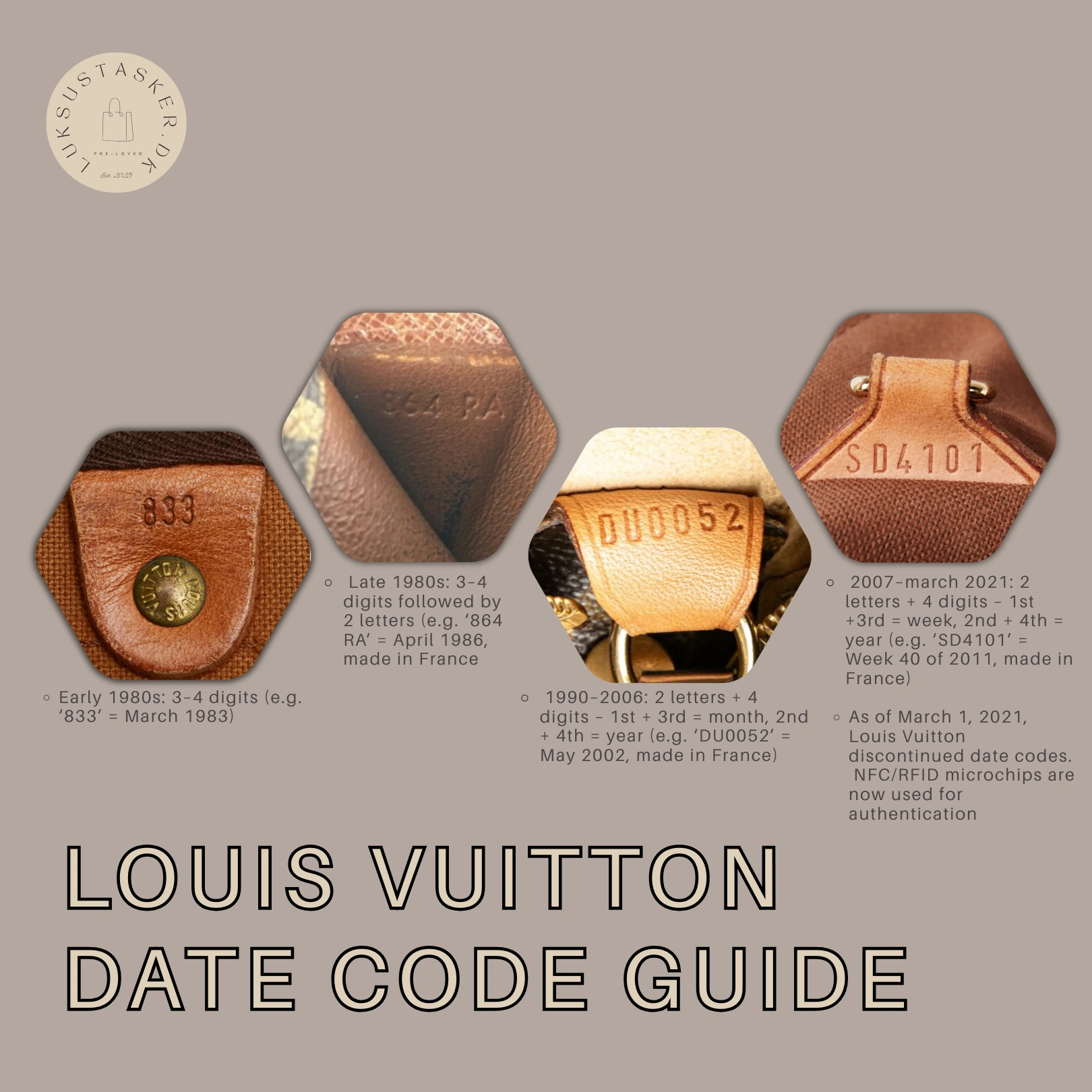
Select a Pickup Point

Shopping cart0
There are no products in the cart!
Continue shopping
Write to us