Are all Mulberry bags “Made in England”? – and why that’s not always the case
Today, genuine Mulberry bags are no longer produced exclusively in England, but also in a number of carefully selected countries, where the brand collaborates with certified manufacturers under strict quality control. Each bag is clearly marked with its country of origin, and the design of the labels has evolved with the year of production and geographical location.
Countries of production for Mulberry bags today:
- England (The Rookery and The Willows, Somerset)
- Turkey
- China
- Italy
- Vietnam
- (Previously also: Spain)
This guide gives you an in-depth look at how the marking of genuine Mulberry bags has evolved over the decades – from the iconic British roots to today’s international manufacturing.
The content is particularly relevant for those who want to be able to assess the authenticity of a Mulberry bag with greater certainty – whether you are considering buying a pre-loved model, are a collector, or simply want to understand the most important characteristics of original brands and materials.
You will get concrete examples, visual descriptions and professional assessment criteria that can help you identify genuine Mulberry bags yourself.
This guide is for informational purposes only and is based on publicly available information, industry sources, collector archives, authentication databases as well as current Industry Authentication Standards and many years of experience with authentic Mulberry bags.
In this guide, we review:
- Origin labels through time – this is how genuine Mulberry bags are marked. The Vintage Period (ca. 1980–1999)
- Black textile labels with country of origin (ca. early 1990s – 2000)
- The Modernization Period (ca. 2000–2010)
- Modern production (from the 2010s onwards)
- Expert advice and authentication – examples of real and fake labels
- Conclusion with professional assessment criteria
1. Origin labels through the ages – how to identify genuine Mulberry bags. The Vintage Period (ca. 1980–1999)
During this period, all Mulberry bags were made exclusively in England – mainly at The Rookery factory in Somerset. The production was handmade, and the focus was on strong, natural leathers.
Typical models from the period:
- Congo leather bags
- Scotchgrain weekend bags
- Darwin leather models – including Roxanne and Bayswater
Marking during the period:
Two types of older leather labels at Mulberry – printing vs. embossing
On vintage Mulberry bags, there are typically two different types of leather labels with logo and origin.
- Printed logo in gold or (rarely) silver – “Mulberry” or “Mulberry Company” (with printed “Made in England”)
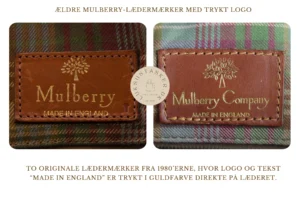
Logo and text (e.g. Mulberry Company – Made in England) are printed directly onto the leather in gold, and in some cases in silver.
The silver-colored version is less common and usually matches the color of the medallion (metal plate) used on the bag.
There is no embossed structure – the writing lies flat on the surface as a decoration.
Typically found on models from the 1980s and early 1990s.
- Lightly embossed logo – “Mulberry” or “Mulberry Company” (with embossed “Made in England”)
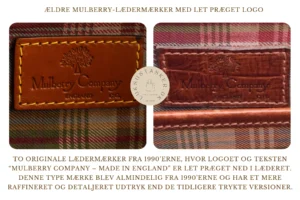
The leather tag shows the classic Mulberry tree and the text Mulberry – Made in England.
The logo and text are lightly embossed into the leather.
This type of label became common from the 1990s onwards.
The label generally appears more refined and detailed than earlier versions.
Export bags marked “Fabriqué en Angleterre”
Some bags exported to France, Belgium and Switzerland were marked “Fabriqué en Angleterre” as part of Mulberry’s export strategy. These labels are rare but 100% authentic.
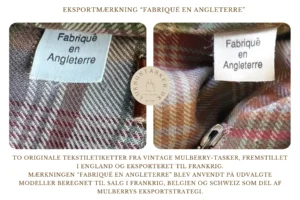
The first Mulberry bags produced outside the UK
The first Mulberry bags produced outside the UK
During the 1990s, Mulberry gradually began to move the production of individual models outside the UK.
The first production countries were Italy and Turkey.
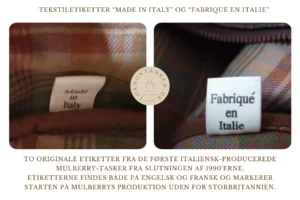
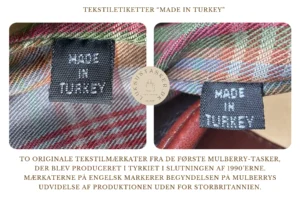
During this period, the original bags were produced with white textile labels for bags made in Italy, marked “Made in Italy” / “Fabriqué en Italie”, and with black textile labels for bags made in Turkey, marked “Made in Turkey”.
These bags marked the beginning of Mulberry’s international production and were produced in small series with the same high standard of craftsmanship as the English models.
2. Black textile labels with country of origin (approx. early 1990s – 2000)
From the early 1990s, the black textile label became the standard for indicating the country of origin on Mulberry bags.
It was used in all countries of production and made it much easier to identify the origin of the bag.
Characteristics:
• Black textile label with white block letters (e.g. MADE IN ENGLAND)
• Placed in the side seam or inside the pocket
• During this period (from the early 1990s to around 2000), a production code is often seen on the back of the black textile label, indicating the factory in the country where the bag was made.
Countries with this type of marking and typical codes (approx. 1990–2000)
Note: Below is only one example of a factory or production code for each country where Mulberry bags were manufactured during the period approx. 1990–2000.
These codes are found on the back of the black textile label where the country of origin is stated.
England
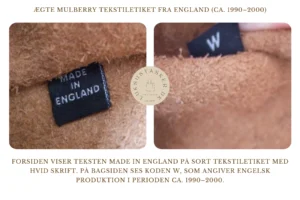 The code W is one of the typical examples that can be found on the back of the black textile label in bags made in England in the period approx. 1990–2000.
Turkey
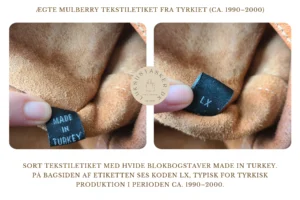 The code LX is one of the typical examples that can be found on the back of the black textile label in bags made in Turkey in the period approx. 1990–2000.
China
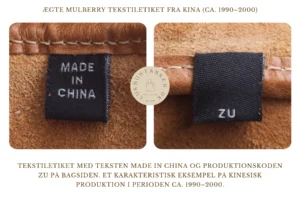 The code ZU is one of the typical examples that can be found on the back of the black textile label in bags made in China in the period approx. 1990–2000.
Spain
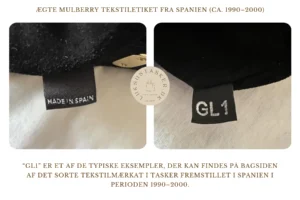
The code GL1 is one of the typical examples that can be found on the back of the black textile label in bags manufactured in Spain in the period approx. 1990–2000.
Note that if the bag is manufactured in Spain and has a code on the back of a black textile label, this is always in capital letters – as shown in the example from Spain.
The most characteristic codes for black textile labels from Spain are GG, GL1, GL2 and GL3.
Additional marking
In some cases, information about the country of production and code was not printed on the black textile label, but instead embossed on a small leather tag.
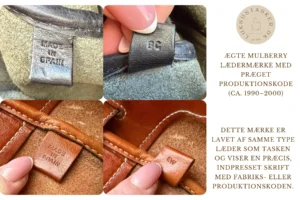
This tag was made of the same type of leather as the bag and had a thin, precise font with a factory or production code on the back.
Rare example
Sometimes an additional small leather tag can be seen placed next to the textile label, made of the same type of leather as the bag, with an embossed code indicating the factory code of the country where the bag was produced.
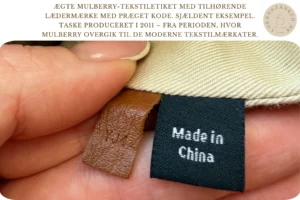
💡Expert tip: On some of the earliest original bags from this period, the production code may be missing on the back of the black textile label.
This is not necessarily a sign of a copy, but the bag should always be assessed in conjunction with other authenticity features, including:
• The placement of the logo and the precision of the workmanship
• The type of leather and surface texture (e.g. Darwin, Classic Grain, Natural Veg Tan)
• The quality and symmetry of the stitching
• Hardware such as snap hooks, buckles, zippers and metal rings
• The structure of the bag (including inner pockets, lining, shape and composition)
• Any metal plate and serial number (if relevant to the model)
• The connection between the model, style and historical period of the bag
3. Modernisation period (approx. 2000–2010)
During this period, Mulberry underwent a gradual modernisation of both production and labelling. Production continued to expand to more countries, but under the same high quality standard and with strict quality control from the head office in Somerset, England.
The black textile labels remained the standard, but the design changed slightly compared to the 1990s. The font became smaller and more compact, and the text was no longer written in all-capital letters as before. The labels were given a more modern and uniform look.
The image shows examples of genuine Mulberry textile labels from the modernization period. For each country, one representative example of a factory or production code used by Mulberry in the production unit in question is shown. The purpose is to illustrate the principle – not to show a complete list of all codes.
The examples cover bags produced in:
• England
• Turkey
• China
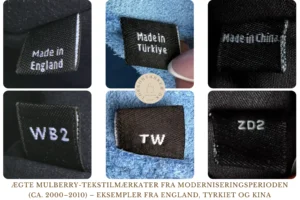
Each code (e.g. England – WB2, Turkey – TW, China – ZD2) is an authentic example from the period and helps identify the country or factory where the bag was made.
Overall, this period was characterized by a more streamlined visual identity in the labeling, while Mulberry maintained its artisanal tradition and high quality control across all production countries.
4. Modern production (from the 2010s to the present)
Today, Mulberry produces its bags in carefully selected countries, where all factories meet the brand’s internal standards for quality, ethics and craftsmanship.
Regardless of where the bag is produced, newer Mulberry bags are equipped with a black textile label with white writing indicating the country of origin, and on the back is the factory production code.
The modern version of the brand clearly differs from previous periods in several characteristic features:
• The font has become thinner, more precise and uniform, reflecting Mulberry’s minimalist design line in recent years.
• The text is machine-embroidered (fine textile printing), which gives a sharp and clear expression.
• The label itself has become smaller in size, supporting the modern and simple expression that characterizes recent collections.
Below are examples of original labels from each of the production countries used by Mulberry in the modern production period (from the 2010s to the present) – they can be used as a reference when authenticating Mulberry bags.
England
Proportion of production: approx. 50–60%
Factories: The Rookery and The Willows (Somerset)
Typical models: Bayswater, Lily, Amberley, Antony and others
Label:
• Black textile label with the text Made in England
• Back with production code – e.g.: WT1
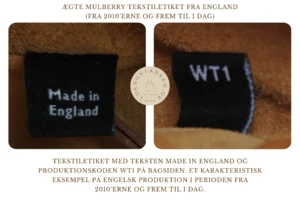
The code WT1 is one of the examples of codes that can be found on the back of the label in bags produced in England from the 2010s to the present.
Turkey
Proportion of production: approx. 20–25%
Application: Soft bag models and textile collections
Label:
• Black textile label with the text Made in Turkey
• Back with production code – e.g.: SM2
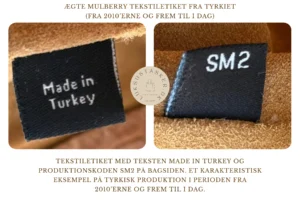
The code SM2 is one of the examples of codes that can be found on the back of the label in bags from Turkey from the 2010s to the present.
China
Proportion of production: approx. 10–15%
Use: Accessories, belts and some standard models
Label:
• Black textile label with the text Made in China
• Back with production code – e.g.: YL3
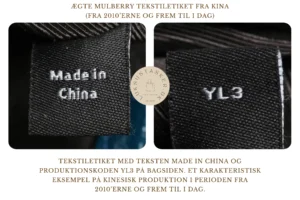
The code YL3 is one of the examples of codes that can be found on the back of the label in bags produced in China from the 2010s to the present.
Italy
Proportion of production: approx. 5–10%
Models: Bayswater Double Zip Tote, seasonal and limited editions
Label:
• Front: Made in Italy
• Back: Production code – e.g.: VY
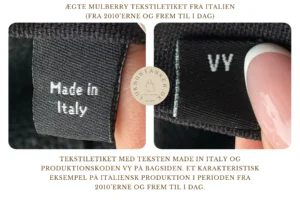
The code VY is one of the examples of codes that can be found on the back of the label in bags from Italy from the 2010s to the present.
Vietnam
Proportion of production: approx. 5–10%
Period: Since the early 2020s
Application: Selected collections and lesser-known models
Label:
• Black textile label with the text Made in Vietnam
• Back with production code – e.g.: YVM
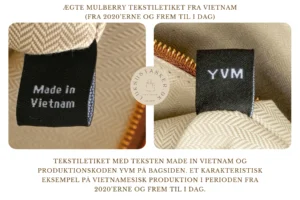
The code YVM is one of the examples of codes that can be found on the back of the label in bags produced in Vietnam from the 2010s to the present.
5. Expert advice and authentication – examples of real and fake labels
💡Expert advice: characteristics of copies – errors in the text “Made in England”
Errors in the text Made in England – especially the letter g, which is often incorrectly shaped, too large or asymmetrical.
On copies, deviations in placement, font and stitching are often seen – the text may appear thicker, uneven or printed with incorrect spacing between the letters.
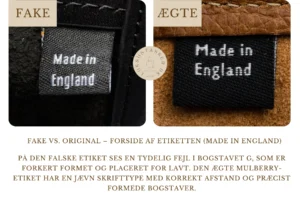
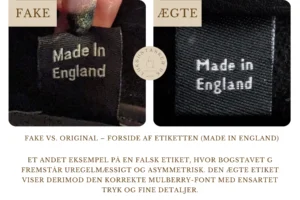 The examples here show labels with the text Made in England, where the fake fonts differ clearly from the original Mulberry font and appear less precise in the details.
💡Expert tip: Characteristics of copies – printed “X” on the back
A printed “X” on the back of the label is a well-documented characteristic of a copy.
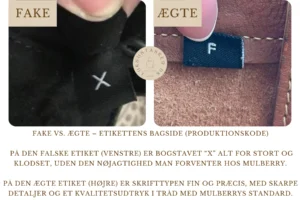
The marking clearly differs from genuine labels in size, font and location and never appears in Mulberry’s original production.
💡Expert tip: Characteristics of copies – the text “Mulberry EST. 1971”
Some counterfeits have the text “Mulberry EST. 1971” on the front or back of the textile label.
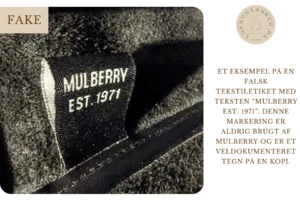
Such a marking has never been used in Mulberry’s original production and is considered a clear characteristic of a copy, as genuine Mulberry bags are only provided with standardized production labels indicating the country of origin and factory code – never the year the brand was established.
6. Conclusion with professional assessment criteria
Mulberry today uses international production without compromising on craftsmanship and quality. A bag marked “Made in England”, “Made in Turkey”, “Made in China”, “Made in Italy”, “Made in Vietnam” or “Made in Spain” can be 100% authentic – as long as it meets the brand’s characteristic features and quality standards.
Genuine Mulberry labels are characterized by:
• Correct typography and precise layout
• A consistent and high quality of processing
• Placement and codes in accordance with the model and period
At luksustasker.dk we assess each individual bag from a holistic perspective, where labeling is only one of many factors. Our authentication system is developed based on thousands of Mulberry bags reviewed – from classic vintage models to the latest collections.
Read more in our blog post: How to recognize a genuine Mulberry bag – details, numbers and materials
At luksustasker.dk, all bags undergo a professional authenticity check based on 30 verifiable parameters – including leather type, stitching, hardware, logo, construction and marking. We have many years of experience with genuine Mulberry bags – from early vintage models to newer collections and limited editions. Our goal is to ensure full transparency and maximum security for you as a buyer – both online and in our showroom in Aalborg.
Also read: FAQ – Frequently Asked Questions