What does a genuine Mulberry serial number look like – and what numbers are typically used on replicas?
When buying a pre-loved Mulberry bag, the serial number is an important part of the authentication – but it should never stand alone. It should always be considered in conjunction with the bag’s other characteristics – including the metal disc, leather type, stitching and logo – as well as other key factors, as we have described in the blog post “Sådan sådan gekender-du-en-aegte-mulberry-taske – detaljer, numre og materialer”.
That is why we have put together this guide to give you a clear and up-to-date overview of how the authentication of Mulberry bags is done in practice.
This guide is for informational purposes only and is based on publicly available information, industry sources, collector archives, authentication databases, applicable Industry Authentication Standards and many years of experience with authentic Mulberry bags.
In this guide we will cover:
- Origin and development of the Mulberry metal disc
- How to recognise a genuine Mulberry metal disc – the front, logo and details over time
- Counterfeit Mulberry serial numbers: The typical telltale signs
- Commonly used copy numbers on counterfeit Mulberry bags (2026)
1. Origin and development of the Mulberry metal disc
Mulberry’s iconic round metal disc has been a central part of the brand’s identity since the early 1990s. It was first introduced as an aesthetic and functional element that was meant to reflect Mulberry’s craftsmanship, authenticity and British design tradition.
Did you know?
Mulberry was founded in 1971 in Somerset, England, originally focusing on belts and small leather goods.
Founder Roger Saul started the business at his kitchen table at the age of just 21, with an investment of £500, which he received as a birthday present from his mother.
The name and logo with the mulberry tree are inspired by his childhood memories of the area where he grew up.
The logo was designed by his sister, Helen, which gives the brand’s identity a personal and family touch.
It was not until the 1980s that Mulberry began to seriously design the bags that are now considered iconic.
- Older vintage models without metal disc
Vintage bags from the late 1980s and early 1990s were produced without the characteristic round metal disc with Mulberry’s mulberry tree logo on the inside.
At this time, Mulberry had a more informal approach to branding and identification – neither serial numbers nor metal discs were yet standard.
The absence of a metal disc is therefore not in itself a sign of a copy, as long as the other details – such as the logo, leather type, stitching, hardware, etc. – are correct consistent with Mulberry’s authentic quality and style from the period.
- Older models with metal disk – but without serial number (approx. 1990–1992)
The first generations:
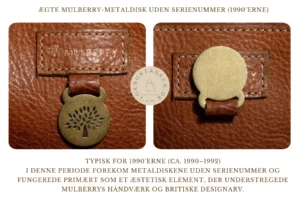
At the beginning of In the 1990s, Mulberry began using the characteristic round metal disc with the mulberry tree logo, placed either on the inside or outside of the bag – depending on the model and design.
During this period, it was quite normal for the back of the metal disc to be blank, i.e. without a serial number.
At that time, the metal disc primarily functioned as a visual design element that signaled the brand’s identity, but did not yet have any function in terms of traceability or authentication via serial number.
Mulberry bags from this period can therefore easily be original, even if the disc does not have a number – provided that the logo, leather, stitching and hardware match Mulberry’s known quality.
This simple approach was gradually replaced as the need for authentication and protection against copycat products grew.
- Gradual introduction of serial numbers (c. 1992–2002)
From around 1992, Mulberry gradually began adding serial numbers to metal discs as part of a strengthened anti-counterfeiting effort.
The first numbers were mechanically embossed on the front near the logo, and later placed on the back of the disc. Common to these early numbers was that they were thin, precise and sans serif – like the logo itself. This characteristic makes them easy to distinguish from replicas.
When evaluating Mulberry bags from this period, it is important to remember that the metal discs that belong to this timeline share a number of common characteristics. This applies in particular to the execution of the logo, the detailing of the name, and the fine and precise lines.
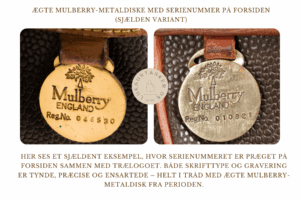
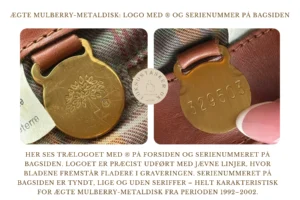
Below are examples where you can also observe variations in the engraving depth of the logo, as well as differences in the location of the serial number (on the front or back of the metal disc). These are production variations – not signs of a replica.
These nuances are fundamental in the authentication of vintage Mulberry bags.
Below are three authentic examples of Mulberry metal disks from the period, clearly showing the differences in detail.
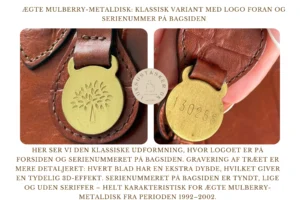
This phase laid the foundation for the next step – a more systematic labeling and improved security, which became standard around the year 2000.
- Approx. 2000–2010: transition period from embossing to laser engraving
During this period, the design of the serial numbers changed significantly:
• Mulberry continued to use metal discs with serial numbers, but the way in which the numbers were applied changed. Whereas earlier numbers were mechanically embossed as thin impressions in the metal, laser engraving began to be used from around 2002.
• The laser engraving was always done in white with a uniform sans-serif font. Font, size and spacing between digits were standardized as Mulberry’s standard for serial numbers.
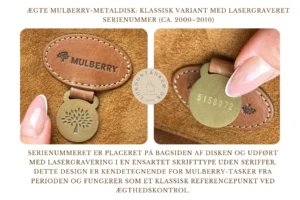
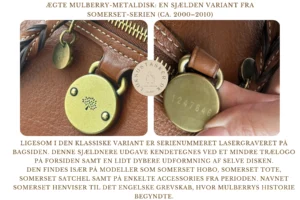
During this period, serial numbers served both for internal identification and as a protection against counterfeit products.
💡 Expert tip: A light patina may develop on genuine vintage serial numbers over time: the numbers do not appear completely white, but take on a greyish hue. This is completely natural and a clear sign of age. Even after cleaning, the numbers will not disappear, as they were laser engraved and not applied with paint.
💡 Expert tip: Mulberry has never used black numbers on serial numbers. If you see a serial number with black or colored digits, it is a sure sign of a copy.
Today, serial numbers play a central role in assessing authenticity, but they should never stand alone. They should always be seen in the context of leather, stitching, hardware, logo and other details – as we have described in the blog post “How to recognize a genuine Mulberry bag – details, numbers and materials”.
- 2010–2016: Standardization and brand identity
From around 2010, Mulberry refined the design of the metal discs, as well as the technique of laser engraving of serial numbers. In the previous period (approximately 2000–2010) on Mulberry models, it was clear that the front of the disc with the logo had a distinctive feature – the wooden logo with gray enamel (colored filling in the recesses of the engraving).• This was a special design element, easily recognizable and part of the brand’s visual identity.
From 2010, Mulberry changed its approach:
• The wooden logo on the disc became without colored enamel – only an embossed engraving in the metal.
• All new collections were then produced with a “pure” metal logo (bronze, gold, silver – depending on the model).
• The absence of black or gray enamel is therefore the norm for genuine bags after 2010 and not a sign of a copy.
It is also important to note that the serial numbers themselves changed their appearance during this period:
• the numbers appeared whiter and with a slightly greater distance between the digits,
• the font became slightly thinner compared to the period 2000–2010,
• the engraving became more precise and uniform – a clear mark of quality for bags from this era.
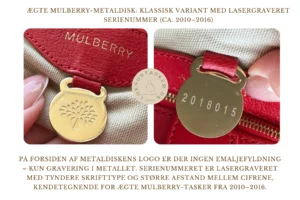
This form of serial numbers and the updated disk design became an integral part of Mulberry’s visual identity and an important reference point in assessing authenticity.
Exceptions and special models:
• Certain mini versions or accessories – e.g. small clutches, cosmetic bags or wallets – could lack a metal disc even during this period.
• Limited or seasonal models, especially made of textile (non-leather), were sometimes produced with a different type of marking – e.g. an embossed logo on a leather label.
- Transition period 2015–2016: Rebranding
During this period, two different variants of serial numbers were used in parallel. The choice of type depended on the model, production batch and the factory in question.
• One variant was the classic numbers that Mulberry used from around 2010 to 2016 on the majority of the collection. They are characterised by a fine, white laser engraving with relatively small digits. Examples of this can be seen in the section 2010–2016: standardisation and brand identity.
• The second variant was newer and more distinctive, with larger and clearer white numbers, such as can be seen in examples of models such as Bayswater and Lily (read more about this type further down in the article).
This parallel practice makes the period 2015–2016 a clear transitional phase in Mulberry’s design history.
- From 2015: Enlarged serial numbers with white laser engraving
Around 2015, Mulberry gradually began using a new type of serial number, where the digits appear slightly larger than in the previous period.
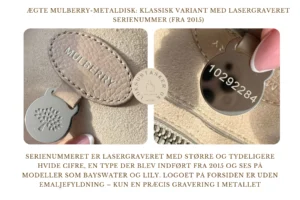
The images clearly show the difference compared to the serial numbers we have described in the section about 2010–2016: standardization and brand identity.
• The serial number is made in white laser engraving with a more precise and uniform cut.
• The font is still sans-serif, but the lines are slightly thicker, which gives the numbers a sharper and more distinctive expression.
• The spacing between the digits is even and standardized, supporting a more modern and refined look compared to the previous, smaller digits.
- After 2016: Modern Mulberry bags: rebranding and gradual phasing out of the metal disc with the serial number
Since 2016, Mulberry has gradually removed the classic metal disc with the serial number on a number of new models. This was part of the brand’s rebranding under Johnny Coca and Thierry Andretta, which introduced a more minimalist and modern look.
Models without a metal disc (fully or partially):
• Softie
• Iris
• Portobello
• Amberley
• Lily (some newer versions)
• Other collections with softer silhouettes
The phasing out of the metal plate has taken place gradually over the course of nearly a decade. As of 2025, only a few models on Mulberry’s official website still featured a metal plate with a serial number—primarily the classic Bayswater, along with selected versions of the Lily.
In 2026, however, Mulberry has expanded the use of the serial-number metal plate across a wider range of models, including the Boston, Woven Tote, Scotchgrain Bucket, Crochet Bucket, Crochet Tote, Crochet Crossbody Bag, Heritage Briefcase, Heritage Zipped Backpack, North South Shopper, and Heritage Medium Clipper. On the official Mulberry website, these models now appear alongside the classic designs, all featuring the serial number on a metal plate positioned on the exterior of the bag.
The 2026 trend clearly signals a return to the metal plate as an integral part of Mulberry’s design DNA.
The serial numbers on these models are identical to the type that Mulberry started using from 2015: larger and clearer white digits, an example of which can be seen in the section 2015–2016: Rebranding and transition period above.
The classic Lily model can still be found with a serial number.
• On the Lily Medium, the metal disc is available in all colours.
• On the Lily in the classic size, the disc is only retained in the basic colours.
• New seasonal colours such as Orchid Bloom Heavy Grain, Brighton Blue Heavy Grain and Chalk Heavy Grain are already produced without a disc – as part of the rebranding.
The decision to phase out the metal plate was driven by several factors: the desire for a more minimalist and modern design expression, reducing weight and wear on the leather, and the fact that the metal plate was increasingly being copied by counterfeiters and therefore losing its value as a marker of authenticity.
Instead, Mulberry chose to strengthen the overall impression through materials, stitching and hardware, which better reflects the brand’s contemporary luxury aesthetic.
💡 Important to remember: The absence of a metal plate or serial number is not a sign of a copy, as long as the bag otherwise complies with Mulberry’s official standards.
⸻
Stability of logo and aesthetics
Throughout the period, the Mulberry logo on the front of the metal plate had a high degree of consistency: the shape of the leaves always had pointed ends, and each leaf was executed with precision and correctly positioned in relation to the brand’s official graphics at the time. The size of the logo could vary slightly, but the quality of the engraving always reflected Mulberry’s high standards of craftsmanship.
2. How to recognize a genuine Mulberry metal disc – the front, the logo and the details over time
When assessing the authenticity of a Mulberry bag, the front of the metal disc plays a crucial role. It is here that the difference between the original and the copy often becomes most apparent.
In this section, we will focus on the front of the metal discs, while in the following article we will examine the back in detail – including serial numbers, engravings and an overview of Frequently Used Copy Numbers on Counterfeit Mulberry Bags (2026).
On genuine Mulberry discs, the mulberry tree logo is always present. The logo has undergone a few changes since the 1980s, but the key elements – the shape of the tree, the balance of the design and the precision of the workmanship – have always been preserved. It is these details that help to distinguish an original from a copy.
By analysing the contours of the tree, the precision of the engraving and the proportions, it is clear how Mulberry has refined its design and craftsmanship standards over different periods.
In this section, we will review the main characteristics of a genuine Mulberry metal disc and show how you can use the front as a sure guide for authentication.
The image below shows different original metal disc versions, illustrating how both the logo and the details have evolved – from the early models to the more recent editions.
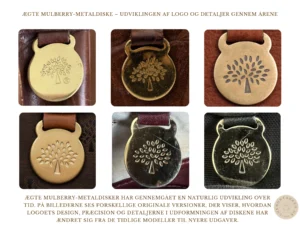
The tree logo: the most important starting point
Over the decades, the Mulberry tree has changed only minimally: the thickness of the lines and the proportions of the crown have been adjusted. However, the basic aesthetics have always been preserved – sharp leaves, symmetry and precise details remain firm hallmarks of authenticity.
The leaves are always clearly marked and placed symmetrically. The crown of the tree is harmonious and balanced, and even small deviations in the proportions can point to a copy.
- Each leaf should have sharp, well-defined ends, and the placement should match the brand’s official graphics exactly.
- The logo should be embossed with depth and precision – never flat, rough or asymmetrical.
- The engraving should appear clean and balanced – without blurring, misaligned lines or incorrect proportions.
- The size of the logo may vary slightly between years, but the shape and placement are always consistent.
A genuine metal disc is not just a decorative element – it represents Mulberry’s heritage and craftsmanship, where even microscopic details count.
Material and weight
Genuine Mulberry metal plates are typically made of brass, which gives them a characteristic golden sheen. Less commonly, variants with a silver or bronze-colored coating are seen. The surface is always smooth, uniform and resistant to wear. Distortions in the details of the wood – leaf shape, crown proportions or trunk contours – are signs of a copy.
💡 Expert tip: Use a magnifying glass or macro photo to check the details – genuine engraving reveals quality when enlarged
3. Fake Mulberry serial numbers: The typical telltale signs
Many copies of Mulberry bags are revealed by one particular detail: the serial number. At first glance, it may look similar to the original – but with the right eye, you will quickly discover small but clear differences.
At luksustasker.dk, we have reviewed and documented over 1000 Mulberry bags – from the earliest limited edition models to the latest collections. We know exactly what each model should look like – down to the smallest details like engraving, placement and font. In this guide, we share our knowledge of the most common mistakes in fake serial numbers so you can confidently distinguish between the real thing and a copy.
Font and number form
The appearance of the serial number quickly reveals whether it is real or fake. The characteristics are clear:
• Genuine serial numbers from this period have a thin engraving, executed in a uniform sans serif font without serifs – always with precise depth and a harmonious expression.
• Fake serial numbers often use fonts with serifs, uneven thickness or an unbalanced expression.
• Numbers such as 1, 2, 4, 6 and 9 with a small “hat” are typical signs of copies.
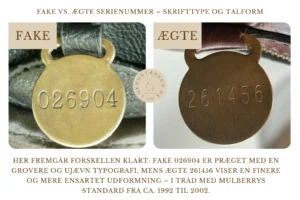
The example shows the difference very clearly:
FAKE 026904 appears rough, with uneven depth and an incorrect font, lacking the precision and balance that characterizes Mulberry.
GENUINE 261456, on the other hand, has a sharp, symmetrical and uniform engraving, completely in line with Mulberry’s standard for vintage bags produced in the period approx. 1992–2002.
Color and surface
The engraving on a genuine Mulberry plate is always discreet and precise. The telltale signs are clear:
• Genuine Mulberry serial numbers are never printed with ink or paint – they are precisely engraved into the metal (vintage models up to around 2002) or laser engraved (from around 2002).
• Many replicas use black ink or paint, making the numbers appear unnaturally dark or “printed”.
• If the numbers can be scratched off or feel uneven, this is a clear warning sign.
• Counterfeit engravings can be rough, uneven in depth or have a dot matrix structure – a technique Mulberry has never used.
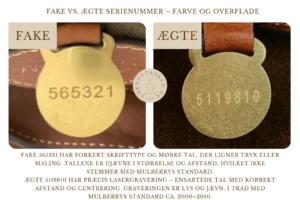
The example here shows the difference very clearly:
FAKE 565321 has the wrong font and dark numbers that appear as printing or paint on top of the metal. In addition, the numbers are uneven in both size and spacing, and the placement does not meet Mulberry’s standards.
GENUINE 5119810, on the other hand, shows precise laser engraving – the numbers are uniform in size, with correct spacing and centering. The engraving appears bright, even and fine, in line with Mulberry’s standard for the period approx. 2000–2010.
Placement and centering
A genuine serial number is always located exactly in the middle of the back of the metal plate – correctly centered and horizontally placed. This gives a balanced and symmetrical appearance.
• Genuine serial numbers are always centrally located, with equal distance to both the top and bottom of the plate.
• There is also no unnecessary empty space before the first or after the last number – the spacing is balanced and follows Mulberry’s standard.
• Regardless of the period the serial number originates from, you will always be able to see a harmonious distance between the numbers, which gives a clean and professional look.
• Copies often have numbers that are crooked, moved up/down or too far to one side.
• Too much space at the beginning or end of the number, or uneven air around the numbers, often reveals a copy.
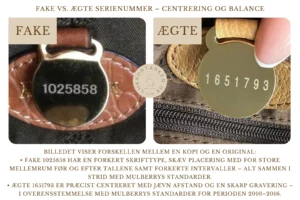
The example here clearly shows the difference:
FAKE 1025858 has an inharmonious placement: visible empty spaces before and after the number and an incorrect font with uneven distances between the numbers. All this gives an unbalanced impression and does not meet Mulberry’s standards.
GENUINE 1651793, on the other hand, shows correct centering with precise spacing, symmetry and no unnecessary space around the numbers. The engraving appears sharp and uniform – completely in line with Mulberry’s standard for the period approx. 2010–2016.
Reused numbers
Copies often share the same serial number – something Mulberry never does.
- A serial number that appears on several different bags or models is a clear sign of a copy
- Authentic Mulberry bags never have identical serial numbers – each bag has its own unique number
- See examples in our overview of known “copy numbers” in section 4 Commonly used copy numbers on counterfeit Mulberry bags (2026)
Quick check: Signs of a fake Mulberry serial number
- Use of black paint or paint
- Incorrect or old-fashioned font
- Numbers of different thickness or shape
- Off-center placement or appear crooked
- Shallow, spotty or uneven engraving
- The number appears on many different bags
💡 Bonus tip: Use a magnifying glass or macro to examine the details – genuine engraving reveals its quality when magnified.
4. Commonly used replica numbers on counterfeit Mulberry bags (2026)
Reused serial numbers – a clear warning sign
One of the most reliable signs of a fake Mulberry bag with a metal disk is the use of a reused serial number – that is, the same number that appears on many different bags, models and colors. This is something Mulberry never does. Each genuine bag has its own, unique serial number.
If you see one of the numbers below – especially if the bag also has cheap hardware, imprecise logos or crooked stitching – it is a clear sign of a copy.

What is the list based on?
The list of known replicas is not based on guesswork or rumors – but on documented knowledge and professional experience. At luksustasker.dk we have:
- Reviewed and documented over 1000 Mulberry bags – both genuine and counterfeit
- Professional experience with authenticity assessment, including details such as serial numbers, engraving and placement
- An active collaboration with international experts in the field of luxury goods authentication
- Access to official reference materials and global databases, which help identify patterns in replicas
- Ongoing monitoring of the second-hand market in 2026 – incl. online marketplaces, auctions and social media
How to use the list
Use the overview as a handy tool when you:
- Considering buying a used Mulberry bag and want to check the serial number
- Have a bag in your collection and want to make sure the number doesn’t appear on replicas
- Want insight into how counterfeits are detected in practice
💡 Important to know: Mulberry never reuses serial numbers.
The serial number is an important part of authentication, but should never stand alone. It should be assessed in conjunction with:
- The materials and stitching of the bag
- Precision of logo and hardware
- Interior details and model knowledge
💡 Expert advice from luksustasker.dk
At luksustasker.dk we evaluate each bag based on more than 30 details – not just the serial number. This includes:
- Quality and type of leather or canvas (including different finishes and embossing)
- Construction, stitching and joints
- The bag’s logo – both precision, placement and font
- Hardware and metal engravings, including locks, chains and buckles
- Relationship with model, year of production and known variations
- Inner lining, labels and any receipt traces
- Wear and patina – how the bag ages can reveal its authenticity
- Scent and the surface feel of the leather – an important indicator across both new and older models
You are always welcome to contact us if you would like more information about a specific bag available on our website.